
When Your Home’s Security is Breached: Understanding the Burglary Insurance Claim Process
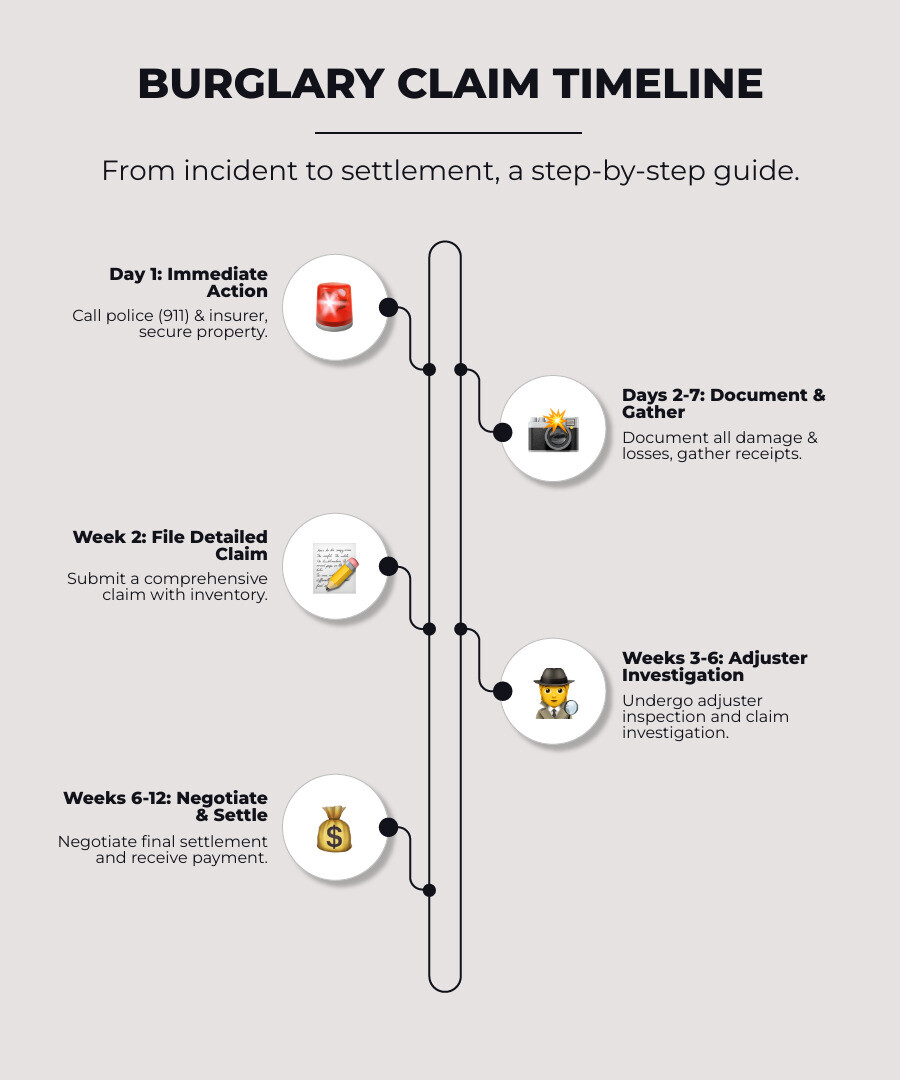
A burglary insurance claim starts the moment you find forced entry into your property. Here’s what you need to do immediately:
- Call 911 if you suspect the intruder may still be inside
- File a police report within 24 hours and obtain a crime reference number
- Document all damage with photos and videos before touching anything
- Contact your insurance company promptly (most require notification within 24-48 hours)
- Create an inventory of all stolen or damaged items with serial numbers and values
- Save all receipts for emergency repairs you make to secure the property
Coming home to find your Arizona property has been broken into is deeply unsettling. Beyond the emotional impact of having your personal space violated, you’re suddenly facing a complex insurance process you likely know nothing about.
The good news: your homeowners or commercial property insurance policy almost certainly covers burglary losses. The challenge: getting a fair settlement requires careful documentation, understanding of policy language, and often skilled negotiation with your insurance carrier.
Most burglary claims involve more than just stolen items. Damage to doors, windows, locks, and walls adds up quickly. Many Arizona property owners find too late that their initial settlement offer doesn’t account for all losses or falls short on replacement values.
In 2019, the FBI reported the average loss per burglary was $2,661. But that’s just the beginning. Without proper documentation and advocacy, many Arizona homeowners settle for far less than their policy actually covers.
Hudson Douglas Public Adjusters has helped Arizona families and businesses steer burglary claims for over 40 years. We handle the entire process—from damage documentation to final settlement—so you can focus on restoring your sense of security. We work on your behalf, not the insurance company’s, and you don’t pay anything out of pocket. We receive 12% of your final payout only after you’re paid.
This guide walks you through every step of filing a successful burglary insurance claim in Arizona, from those first moments after finding the break-in to securing a complete settlement.
Find more about Burglary insurance claim:
Immediate Steps After a Break-In
The moments following the findy of a break-in are often a blur of adrenaline and anxiety. However, the actions you take in the first hour can significantly impact the outcome of your burglary insurance claim. Your first priority is safety. If you arrive home and see a broken window or an open door, do not enter. The intruder may still be inside. Go to a safe location—like a neighbor’s house or your car—and call 911 immediately.
Once the police have cleared the scene, your next step is to obtain a police report. This is not just a formality; most insurance companies will not even open a burglary insurance claim without an official case number. While the officers are there, take note of the responding officer’s name and badge number.
Before you start cleaning up glass or boarding up windows, you must document the scene. Think of yourself as a forensic investigator. Take high-quality photos and videos of every point of entry, every damaged lock, and every room where items were tossed or stolen. This visual evidence is crucial because once you start repairs, the “proof” of the crime’s severity begins to disappear.
After documentation, you have a “duty to mitigate” further loss. This means you must make temporary emergency repairs to secure your home from weather or secondary intruders. If a window is smashed, board it up. If a door is kicked in, have a locksmith replace the deadbolt. Keep every single receipt for these services and materials; these costs are typically reimbursable as part of your claim.
Understanding Your Burglary Insurance Claim Coverage
To steer your claim, you need to understand the language the insurance company uses. In insurance, terms like “theft,” “burglary,” and “robbery” aren’t interchangeable—they have specific legal and policy definitions that determine if you are covered.
- Burglary: Traditionally defined in insurance policies as the taking of property from a premises that has been entered by force or violence. Crucially, most policies require visible marks of entry made by tools, explosives, or chemicals.
- Theft (Larceny): A broader term that simply means the act of stealing. It doesn’t necessarily require forced entry. If someone walks through an open uped door and takes your laptop, that is theft, but it might not meet the policy definition of “burglary.”
- Robbery: This involves taking property from a person by force or the threat of force (a “hold-up”).
The history of these definitions is fascinating. In the early 1920s, as automobiles became common, crime rates shifted. For example, in 1922, Chicago saw over 4,300 burglaries. Insurance companies had to refine their definitions to distinguish between a “cat burglar” sneaking in and a violent “hold-up.” Today, these distinctions still matter because your policy might have different limits for each. For instance, a standard policy might cover “theft,” but a specific “burglary” endorsement might be required for higher-value commercial inventory. You can learn more about these distinctions at Theft & Vandalism.
Filing Your Burglary Insurance Claim
Once you have your police report and your initial photos, it’s time to pick up the phone. You should notify your agent or insurance company as soon as possible—ideally within 24 hours. Have your policy number ready. Be honest but concise; tell them what happened based on the facts in the police report. Avoid speculating on the total value until you’ve had time to do a full inventory. For residents in the Valley or Northern Arizona, getting local help is often best. More info about insurance claim help in Arizona can provide insights into how regional adjusters handle these local filings.
Policy Provisions and Classes
Not all property is treated the same. Insurance policies often categorize coverage into “classes.”
- Residence Burglary: Covers personal belongings inside your home.
- Mercantile Open Stock: For business owners, this covers inventory stolen from a store.
- Bank Robbery/Safe Deposit: Specific coverage for banks and those who store valuables in them.
Pay close attention to “unoccupancy clauses.” If you are a snowbird and your home in Scottsdale or Mesa is left vacant for more than 30 or 60 days, your coverage for a burglary insurance claim might be suspended unless you’ve notified the carrier and potentially paid a higher premium.
Essential Documentation for Success
The “Big Check” mentioned in the title of this article is only possible if you can prove what you owned. The insurance company isn’t just going to take your word for it that you had a $5,000 watch or a top-of-the-line camera system.
You need to compile a comprehensive inventory. For every item stolen or damaged, try to provide:
- Description: Make, model, and serial number.
- Proof of Ownership: Receipts are gold, but bank statements, credit card records, or even old photos of the item in your home can work.
- Replacement Cost: What would it cost to buy that exact item today?
High-Value Items to Document:
- Electronics (Laptops, Gaming Consoles, TVs)
- Jewelry and Watches (Anything over $1,500 usually needs a separate “rider”)
- Firearms
- Tools and Equipment (Especially for commercial property owners)
- Designer handbags and apparel
If you don’t have receipts, don’t panic. Check your email for digital order confirmations or your bank app for transaction history. Providing a detailed, organized list makes it much harder for an insurance adjuster to “lowball” your payout. For more tips on building a bulletproof case, see More info about maximizing residential claims.
Factors Influencing Your Burglary Insurance Claim Settlement
The amount you receive depends heavily on two terms: Actual Cash Value (ACV) and Replacement Cost Value (RCV).
| Feature | Actual Cash Value (ACV) | Replacement Cost Value (RCV) |
|---|---|---|
| Definition | Cost to replace minus depreciation | Cost to buy new today |
| Payout | Lower (based on age/wear) | Higher (full price of new item) |
| Premium | Usually cheaper | More expensive |
Most standard policies start at ACV. If your five-year-old TV is stolen, ACV pays you what that used TV was worth yesterday (maybe $100). RCV pays you what a brand-new, similar TV costs today (maybe $600). Understanding these limits and your deductible is vital. If your loss is $2,000 and your deductible is $1,000, your check will only be for $1,000. Statistics from the FBI’s Uniform Crime Reporting Program show that many victims are underinsured for the true cost of their lost peace of mind.
How Insurers Investigate and Calculate Payouts
Once you file your burglary insurance claim, the company will assign a field adjuster. It is important to remember that this person works for the insurance company, not you. Their job is to verify the claim and look for reasons to limit the payout.
They will conduct a “claims investigation.” This involves inspecting the physical damage to your Arizona home and reviewing your “Proof of Loss” statement—a formal document where you swear to the accuracy of your list. They may also look for “co-insurance” issues. In commercial policies, if you haven’t insured your building for at least 80% of its value, the company can legally penalize your payout.
To understand the difference between their adjuster and an independent advocate, read More info about public adjusters vs insurance adjusters. You can also learn more about the Home Insurance Claim Investigation Process to know what to expect during their visit.
Substantiating Your Burglary Insurance Claim
The adjuster is looking for visible marks of forced entry. If a thief used a “bump key” or entered through an open uped window, the adjuster might try to reclassify the claim as “theft” rather than “burglary,” which could have lower limits. We often use forensic techniques or witness statements to prove the method of entry. If you feel the insurance company’s initial assessment is wrong, you always have the right to a second opinion insurance claim through a public adjuster.
Common Exclusions and Policy Limitations
Insurance policies are full of “gotchas” known as exclusions. Even with a valid burglary insurance claim, you might find your payout capped in certain areas:
- Sub-limits: Most policies limit jewelry, furs, and cash to small amounts (often $1,000 to $2,500 total) unless you specifically “scheduled” them beforehand.
- Business Property: If you run a business out of your home in Gilbert or Chandler, your homeowners policy may not cover your professional equipment.
- Property of Others: If you were fixing a friend’s computer and it was stolen, it might not be covered under your standard policy without a specific endorsement.
- Employee Theft: If a housekeeper or contractor steals from you, this is often excluded from burglary coverage and requires “employee dishonesty” coverage.
For business owners, More info about maximizing commercial claims explains how to steer these trickier commercial exclusions.
Navigating the Process in Arizona
Whether you live in a historic home in Prescott or a modern condo in Paradise Valley, Arizona law provides specific protections for policyholders. For example, if you are a renter in Tempe or Goodyear, your landlord’s insurance covers the building, but only your renters insurance covers your stolen belongings and the damage to your personal furniture.
At Hudson Douglas, we are proud to be a local, family-owned Arizona business. We understand the specific needs of our community, from the unique construction styles of Catalina Foothills to the commercial realities of Mesa. We also believe that language should never be a barrier to justice. We offer full support in both English and Spanish, ensuring our Spanish-speaking neighbors in places like San Tan Valley or Tucson receive the same high-level advocacy.
If you are feeling overwhelmed, an Arizona Public Adjuster can take the burden off your shoulders. We handle the paperwork and the “back-and-forth” with the carrier. You can find More info about public adjusters for homeowners to see if this path is right for your family.
Frequently Asked Questions about Burglary Claims
How long do I have to file a claim after a theft?
While most policies give you up to 30 days to notify them, it is highly recommended to report a burglary insurance claim within 24 to 48 hours. Most insurers require a claim to be fully filed (with all documentation) within 180 days of the incident.
Can I file a claim if there are no signs of forced entry?
Yes, but it will likely be processed as a “theft” claim rather than “burglary.” Check your policy limits for “theft” versus “burglary.” If a thief entered through an open uped door, you are still covered for the loss of property, but the “damage to premises” portion of the claim might be non-existent.
Will my insurance rates go up after a burglary claim?
Because burglary is generally considered a “non-fault” claim, the impact on your rates is often minimal compared to a liability or fire claim. However, your overall claims history and the total payout amount can influence your premiums at renewal time.
Conclusion
A burglary is more than a financial loss; it is a violation of your sanctuary. Navigating a burglary insurance claim shouldn’t add to that trauma. By following the steps of documentation and understanding your policy’s fine print, you can move from “broken windows” to the “big check” you need to rebuild.
Hudson Douglas Public Adjusters is here to ensure that the insurance company plays fair. With over 40 years of expertise and a deep commitment to our Arizona roots, we stand as your dedicated advocate. We don’t charge upfront fees, we are available 24/7, and we only get paid if you do (12% of the settlement). Whether you are in Scottsdale, Flagstaff, or Sedona, we treat your claim like it was for our own family.
Don’t settle for a lowball offer. Let us handle the stress of the claim so you can focus on getting your life back to normal.
Contact Hudson Douglas Public Adjusters today for a free consultation.