Commercial Property Damage: What to Check First
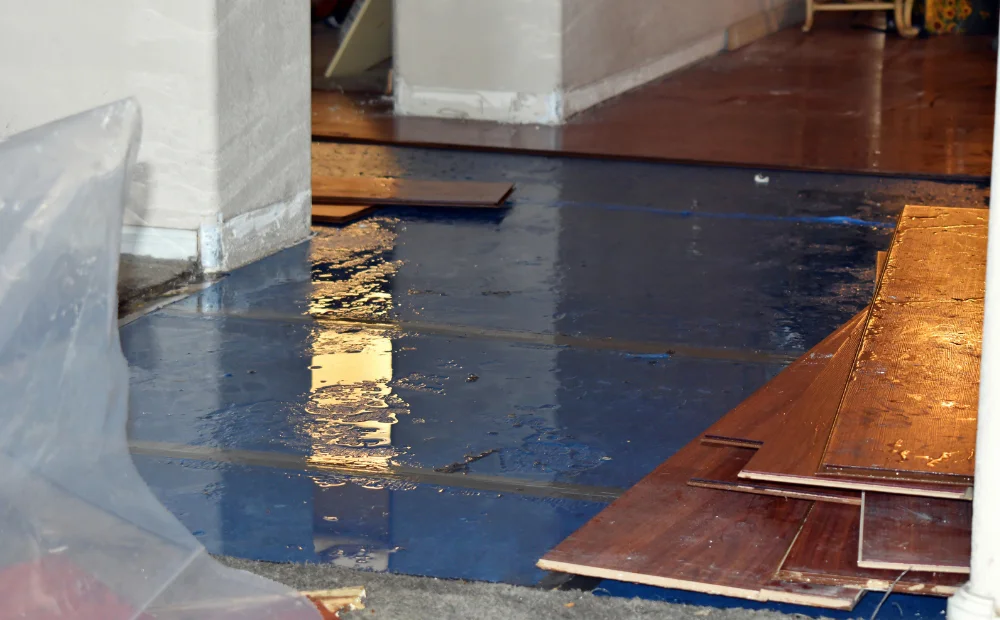
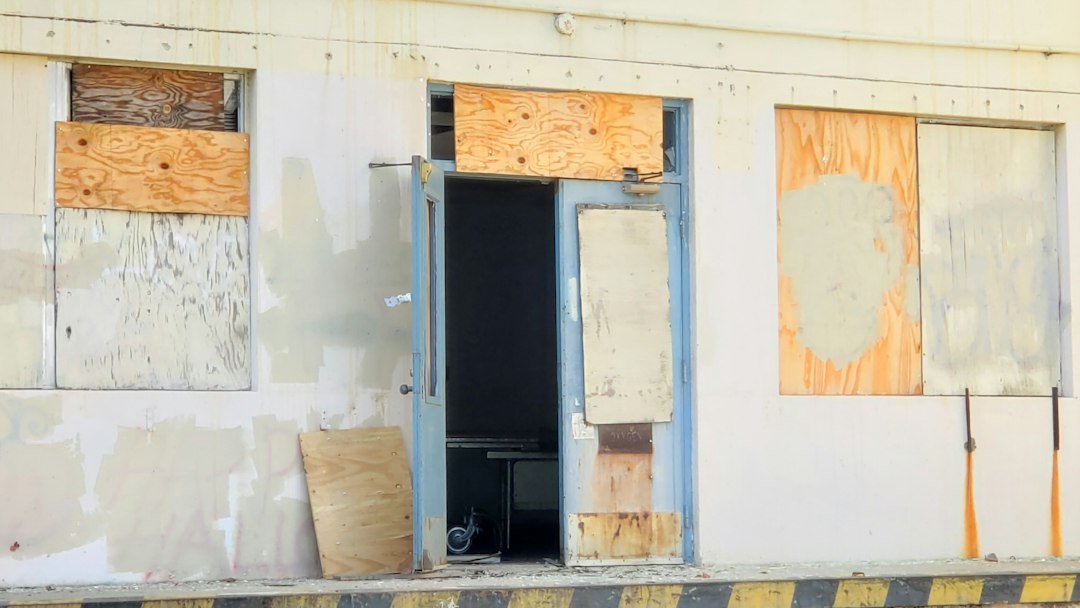
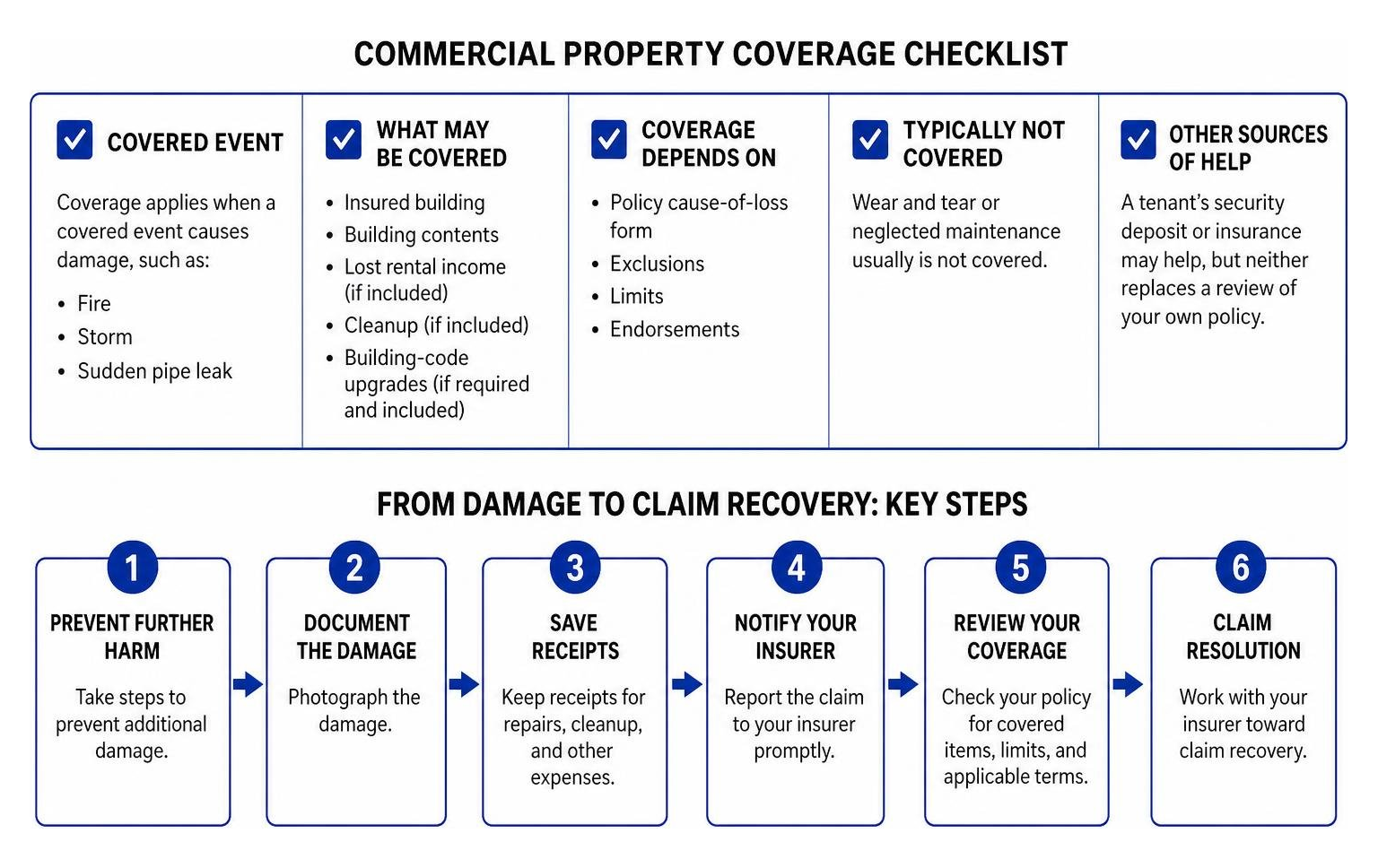
Commercial property damage may be covered when a covered event, such as a fire, storm, or sudden pipe leak, harms an insured building or its contents. Coverage depends on the policy’s cause-of-loss form, exclusions, limits, and endorsements. Wear and tear or neglected maintenance usually is not covered.
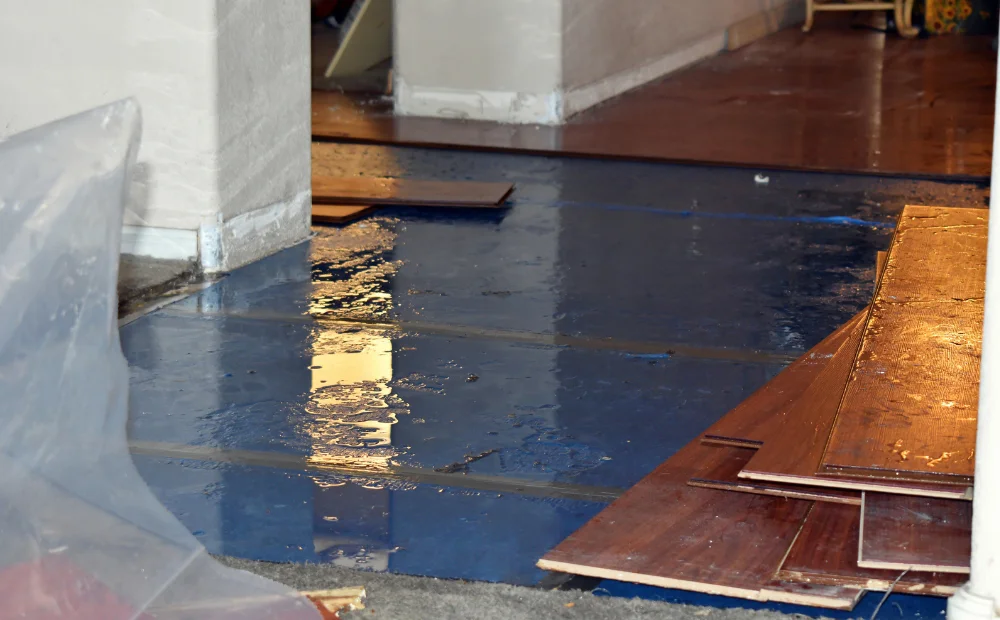
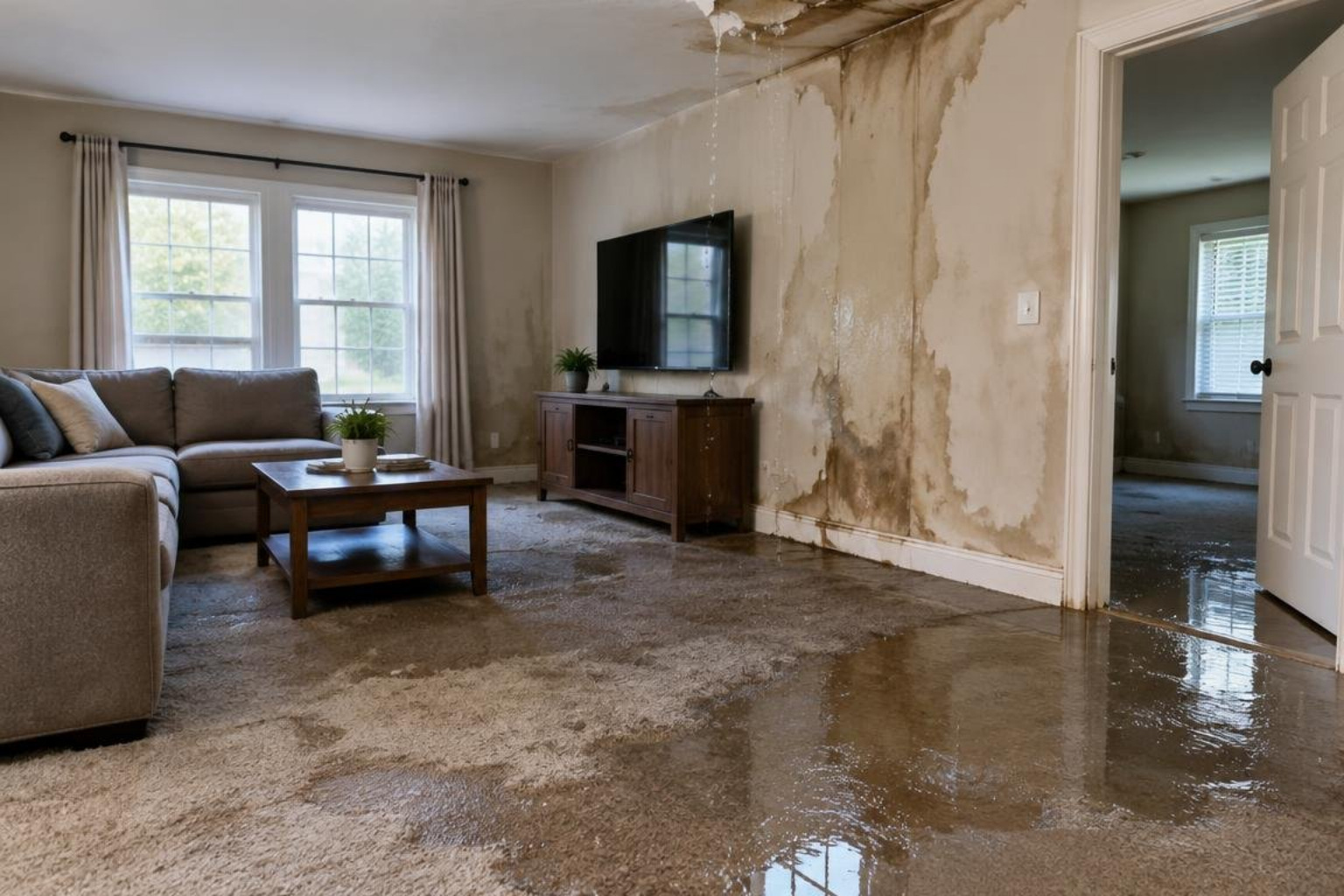
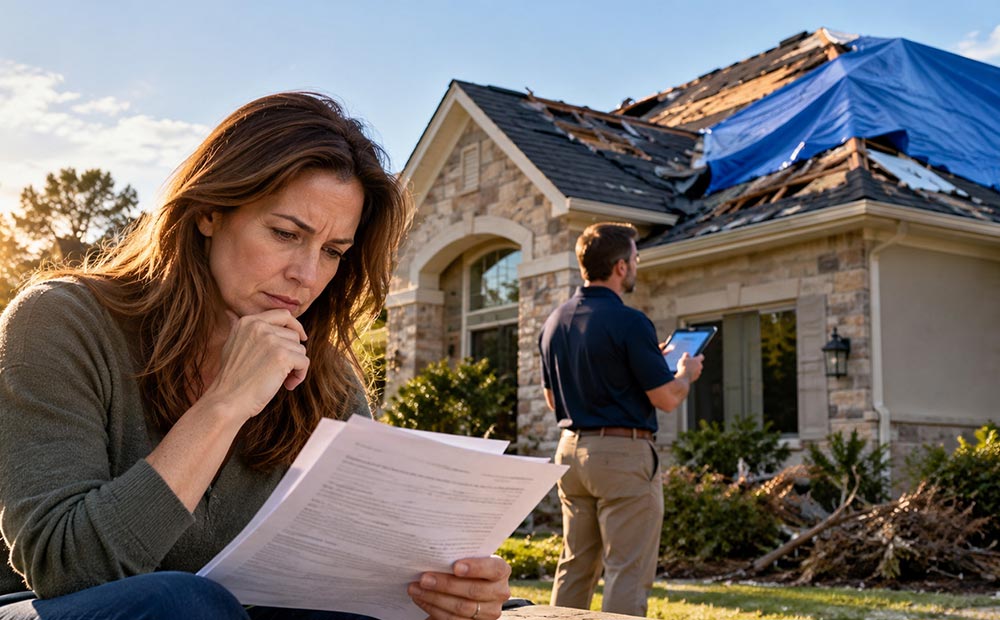
If your property was just damaged, take steps to prevent further harm, photograph the damage, save receipts, and notify your insurer promptly. Check whether your policy also covers lost rental income, cleanup, or required building-code upgrades. A tenant’s security deposit or insurance may help, but neither replaces a review of your own policy.
I’m Douglas Waldie with Hudson Douglas Public Adjusters, a family-owned, locally based Arizona business that represents policyholders only in residential and commercial property insurance claims.
Understanding Commercial Property Damage and Policy Structures
Navigating commercial insurance requires understanding how coverage forms interact. A standard commercial policy is built from several building blocks: the declarations page, coverage forms, cause-of-loss forms, and endorsements. The declarations page establishes your policy limits, deductibles, coinsurance percentages, and named insured locations.
Whether you operate an office park in Scottsdale, manage retail spaces in Gilbert, or oversee industrial warehouses in Mesa, your policy language dictates what qualifies as an insured premise, how losses trigger payouts, and what responsibilities fall on your shoulders.
Defining Commercial Property Damage Under ISO and MSO Forms
Most commercial property policies in the United States follow standardized forms established by the Insurance Services Office (ISO) or the Management Services Organization (MSO), such as the MSO General Property Form MCP 010 06 12.
These forms generally divide physical assets into three categories:
- Building Coverage: Covers the primary structures, completed additions, permanently installed fixtures, machinery, and equipment used to service the building (such as HVAC systems and fire suppression units).
- Business Personal Property (BPP): Protects furniture, inventory, machinery, supplies, and other unattached contents owned by the business.
- Personal Property of Others & Tenant Improvements: Protects property in your care, custody, or control, including improvements and betterments made by or for a tenant.
One critical detail in both ISO and MSO forms is the spatial perimeter rule. Standard coverage forms typically protect business personal property located inside the building or outdoors within 100 feet of the described premises. If you store high-value inventory or heavy equipment in an exterior yard beyond that 100-foot perimeter, specialized endorsements are required to prevent severe coverage gaps.
Comparing Causes of Loss: Basic, Broad, and Special Forms
Commercial policies do not provide blanket protection automatically. Instead, they use specific cause-of-loss forms that establish what hazards are insured against. Understanding those differences helps commercial property owners evaluate coverage and prepare stronger claims.
| Cause of Loss Form | Perils Covered | Burden of Proof | Key Distinctions |
|---|---|---|---|
| Basic Form (CP 10 10) | Named perils only (Fire, lightning, explosion, windstorm, hail, smoke, aircraft/vehicle damage, riot, vandalism, sinkhole collapse, volcanic action). | Policyholder must prove the damage resulted from a specifically listed peril. | Highly restrictive; excludes water damage, collapse, and falling objects. |
| Broad Form (CP 10 20) | Named perils from Basic Form plus falling objects, weight of snow/ice/sleet, accidental water discharge/leakage, and abrupt collapse. | Policyholder must prove a listed peril caused the loss. | Adds vital protection against interior water leaks and roof collapse from weight. |
| Special Form (CP 10 30) | Open perils (All direct physical loss is covered unless specifically excluded or limited). | Insurer must prove the loss is excluded under the policy terms. | Most comprehensive; covers theft and mysterious physical damage, shifting proof to the insurer. |
The choice between a named-peril policy and an open-peril Special Form significantly alters claim negotiations. Under a Special Form, if a sudden event harms your commercial building, the carrier must cite a specific exclusion—such as continuous wear, ordinance enforcement, or flood—to deny payment.
Tenant Damage, Commercial Leases, and Landlord Coverage
When leasing commercial space, property owners often face complex situations when a tenant causes damage. Lease agreements establish contractual liability, but insurance policies determine who pays when major losses occur.

Accidental Commercial Property Damage vs. Normal Wear and Tear
Commercial landlord policies are designed to cover sudden and accidental events. If a tenant’s commercial kitchen equipment catches fire or a salon plumbing line suddenly ruptures overnight, the resulting structural destruction represents a covered direct physical loss.
However, policies strictly exclude:
- Normal wear and tear: Scuffed drywall, worn carpet, faded paint, and aged fixtures.
- Neglect and poor maintenance: Deterioration from failing to service cooling towers, roof seals, or plumbing lines over time.
- Deliberate or intentional damage: Although external vandalism is generally covered under standard policies, intentional destruction by an insured party is excluded.
When damage stems from sudden operational accidents, landlord insurance protects the core structure, while the lease agreement determines whether the tenant reimburses deductibles or uninsured expenses.
Security Deposits vs. Commercial Property Insurance
Many landlords assume a commercial security deposit protects against tenant-related property destruction. In reality, a security deposit rarely covers structural repairs.
| Scenario | Typical Security Deposit | Actual Repair Cost | Financial Shortfall Without Claim Advocacy |
|---|---|---|---|
| Commercial Kitchen Fire | $5,000 – $15,000 | $150,000 – $350,000 | $135,000+ |
| Multi-Unit Plumbing Blowout | $4,000 – $10,000 | $60,000 – $120,000 | $50,000+ |
| Vehicle Impact to Storefront | $3,000 – $8,000 | $40,000 – $90,000 | $32,000+ |
| Substantial Vandalism & Theft | $5,000 – $12,000 | $35,000 – $75,000 | $23,000+ |
Relying solely on a security deposit for significant structural events can leave commercial property owners with substantial losses. Submitting an insurance claim remains necessary to restore the premises.
Mandatory Tenant Insurance Requirements
To manage risk, commercial leases should mandate that tenants maintain adequate coverage naming the property owner as an additional insured:
- Commercial General Liability (CGL): Typically $1,000,000 per occurrence / $2,000,000 aggregate, covering bodily injury and third-party property damage.
- Tenant Business Personal Property Insurance: Covers tenant inventory, trade fixtures, and interior build-outs so tenant losses do not trigger disputes over landlord policy limits.
- Commercial Umbrella Coverage: Provides additional excess liability limits ($2,000,000 to $5,000,000+) above baseline general liability policies.
- Certificates of Insurance (COI): Annual verified certificates confirming that the landlord is listed as an additional insured with a waiver of subrogation.
Essential Supplemental Coverages and Business Interruption
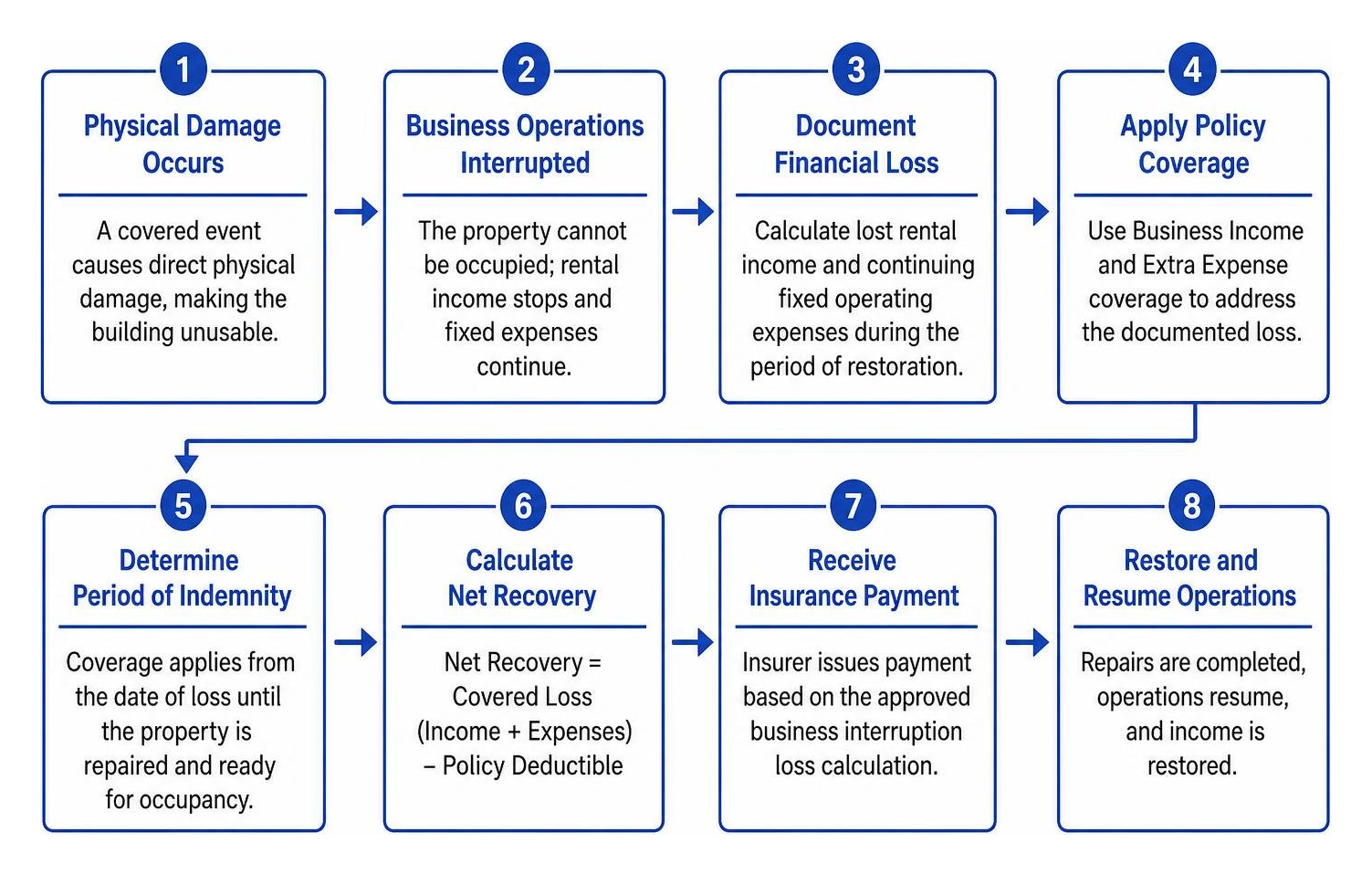
Direct physical repairs represent only part of the recovery equation. When a building cannot be occupied, lost rental income and ongoing operating expenses can quickly threaten financial stability.
Business Income and Extra Expense Recovery
Business income coverage compensates commercial landlords and business owners for lost net profits and continuing fixed operating expenses (such as mortgages, property taxes, security, and essential payroll) while a building undergoes repair.
Reviewing our guide to navigating business interruption claims helps clarify how these recoveries function:
- Basic Period of Indemnity: Begins either at the time of loss or after a standard 72-hour waiting period, ending when the property is restored to operational condition.
- Extended Period of Indemnity: Provides an additional 30 to 60 consecutive days of income recovery to allow customer traffic and tenant occupancy to stabilize.
- Civil Authority Coverage: Provides up to 14 consecutive days of lost business income if local emergency authorities prohibit access to your premises due to nearby damage.
Supplemental Protections: Ordinance or Law and Debris Removal
Standard reconstruction coverage only pays to restore a building to its pre-loss condition. However, municipal building codes often require older commercial buildings to be modernized during major repairs.
- Ordinance or Law Coverage: Pays for mandatory upgrades required by local authorities during reconstruction, such as modern fire suppression sprinklers, ADA handicap accessibility ramps, updated electrical panels, or seismic reinforcement.
- Debris Removal Coverage: Standard ISO forms allocate 25% of the direct physical loss plus the deductible for debris cleanup, with additional endorsements providing $25,000 or more per location.
- Spoilage and Contamination: Protects perishable inventory lost to off-premises utility power failures or mechanical breakdown.
Navigating the Commercial Claim and Settlement Process
Successfully resolving a complex commercial claim requires meticulous documentation, prompt communication, and a clear understanding of valuation methodologies.
Documenting Loss and Meeting Policyholder Duties
After an incident occurs, policyholders must satisfy strict post-loss obligations to protect their coverage:
- Immediate Loss Mitigation: Take reasonable steps to prevent secondary damage, such as tarping exposed roofs, boarding broken windows, and extracting standing water. Keep detailed invoices for all emergency stabilization.
- Comprehensive Damage Cataloging: Take high-resolution photographs and videos of structural damage, mechanical systems, and damaged inventory before debris removal begins. For severe exterior storms, follow our guidance on assessing commercial roof damage.
- Complying with Deadlines: Adhere to all policy timelines, including submitting a notarized Sworn Proof of Loss within the carrier’s specified timeframe (often 60 days). Review our guide on claim documentation requirements to ensure your paperwork satisfies carrier scrutiny.
Calculating Settlements: RCV, ACV, and Coinsurance Formulas
Insurance carriers calculate initial payments using specific formulas that separate immediate payouts from holdbacks.
- Actual Cash Value (ACV): The fair market value of damaged property at the time of loss, calculated as Replacement Cost Value minus physical depreciation. Carriers issue this initial check to begin work.
- Replacement Cost Value (RCV): The total cost to repair or replace property with materials of like kind and quality at current market prices, without deductions for depreciation.
- Depreciation Holdback: The difference between RCV and ACV, released by the carrier only after repairs are completed and verified by contractor invoices.
Commercial property owners must also watch for the Coinsurance Clause. If your policy requires you to carry insurance equal to 80% or 90% of the building’s true replacement value, being underinsured triggers severe financial penalties. The claim payout is calculated by dividing the amount of insurance carried by the amount of insurance required, multiplying that ratio by the loss amount, and then subtracting the deductible.
For example, if a commercial building with a true replacement value of $1,000,000 carries an 80% coinsurance requirement ($800,000 required), but the owner maintains only $400,000 in coverage, the insurer will pay only 50% of any covered loss (minus the deductible). Understanding these mechanisms is essential to properly maximize your commercial property damage insurance claim.
If valuation disputes stall your claim, most policies include an Appraisal Clause, allowing policyholders to demand an independent, binding valuation without entering lengthy litigation.
Frequently Asked Questions About Commercial Claims
What is Ordinance or Law coverage in a commercial property claim?
Ordinance or Law coverage pays for the increased costs of construction required to bring a damaged structure into compliance with current municipal building codes, ADA accessibility guidelines, and local zoning laws during repair. Standard property policies pay only to restore what existed before the loss; without Ordinance or Law endorsements, required code upgrades must be paid out of pocket.
How does the 60-day vacancy rule impact coverage?
Under standard ISO and MSO property forms, if a commercial building remains vacant or unoccupied for 60 consecutive days prior to a loss, the policy automatically suspends coverage for vandalism, sprinkler leakage, glass breakage, water damage, and theft. For other covered perils, payouts may be reduced by 15%. If your property experiences prolonged tenant vacancies or undergoes extended renovation, securing a vacant-building endorsement protects your investment.
What happens if repair costs exceed a tenant security deposit?
When tenant-caused damage exceeds the security deposit, the property owner should file a claim under their commercial property policy to fund structural repairs. Once the insurer pays the claim, they may exercise subrogation rights against the tenant’s commercial general liability policy to recover the costs. The landlord can also seek recovery for their deductible and uninsured losses directly from the tenant under the terms of the commercial lease agreement.
Conclusion
Commercial property damage brings complex logistical, financial, and operational challenges. Successfully restoring your commercial building requires a thorough understanding of policy forms, proactive risk management through lease agreements, and meticulous documentation from the moment a loss occurs.
Navigating carrier adjusters, depreciation holdbacks, and coinsurance calculations can place heavy demands on your time. At Hudson Douglas Public Adjusters, we are a family-owned and operated, locally based Arizona business dedicated exclusively to representing residential and commercial policyholders. Our team operates across Arizona—including Paradise Valley, Queen Creek, Gilbert, Scottsdale, Chandler, Goodyear, Mesa, and San Tan Valley—as well as Clark County, Nevada, and the Utah Wasatch Front.
We work solely on behalf of property owners to handle inspections, build comprehensive line-item estimates, and negotiate directly with insurance carriers. Our services require no upfront or out-of-pocket costs; we receive 12% of the final claim payout only when your settlement is secured. If your commercial property has sustained damage, contact us 24/7 for knowledgeable, professional claim support.