When the Settlement Doesn’t Add Up: Recognizing Bad Faith in Property Claims
A bad faith insurance claim occurs when your insurance company violates its duty to deal with you fairly and honestly during the claims process. After disaster strikes your Arizona property, the last thing you need is an insurer who delays, lowballs, or denies your legitimate claim without reasonable cause.
Quick Answer: Is Your Insurer Acting in Bad Faith?
Your property insurer may be breaching their duty of good faith if they:
- Deny your claim without a reasonable explanation or supporting evidence
- Unreasonably delay investigating or paying your property damage claim
- Offer a settlement far below what your damage actually costs to repair
- Misrepresent your policy language to justify a lower payout
- Fail to communicate or ignore evidence you’ve provided
- Conduct a biased investigation that overlooks obvious damage
Insurance contracts include an implied covenant of good faith and fair dealing. That means your insurer is legally required to treat you fairly, investigate your claim thoroughly, and pay what you’re owed under your policy. When they don’t, it’s not just frustrating—it may be illegal.
Bad faith goes beyond a simple disagreement over claim value. It involves conduct that is unreasonable, deceptive, or deliberately harmful to you as the policyholder. Understanding what constitutes bad faith helps you recognize when your insurer has crossed the line from tough negotiation into unlawful behavior.
At Hudson Douglas Public Adjusters, we’ve spent over four decades representing Arizona homeowners and commercial property owners through the claims process. As a locally based, family-owned business, we’ve seen how insurers sometimes handle claims in ways that fall short of their legal obligations. We work exclusively for policyholders—never insurers—to document damage thoroughly, negotiate fairly, and help you secure the settlement your policy actually promises.
Whether you’re dealing with fire damage, water damage, storm losses, or any other covered property disaster, knowing the signs of bad faith protects your rights and your recovery. This guide walks you through what bad faith means, how to spot it, and what steps to take if you suspect your insurer isn’t playing fair.
Bad faith insurance claim definitions:
Defining the Bad Faith Insurance Claim
In property insurance, “bad faith” isn’t just a term for poor customer service; it is a specific legal concept rooted in tort law. While a standard insurance claim is a matter of contract law—you pay premiums, they pay for losses—a bad faith insurance claim arises when the insurer’s conduct is so egregious that it becomes a “tort,” or a civil wrong.
In the United States, insurance is primarily regulated at the state level. This is due to the McCarran-Ferguson Act, which gives states like Arizona, Nevada, and Utah the authority to govern the insurance industry within their borders. In Arizona, for example, the state legislature has established statutes that mandate how insurers must behave. When an insurer ignores these rules, they aren’t just breaking a promise; they are violating state law.
Historical Origins of Bad Faith
The concept of bad faith has evolved significantly over the last century. Historically, if an insurer refused to pay a claim, the only remedy was a breach of contract suit, which usually only recovered the money owed under the policy. However, landmark cases like Comunale v. Traders & General Ins. Co. (1958) and Gruenberg v. Aetna Ins. Co. (1973) changed the landscape. Courts began to recognize that because insurance is a necessity and policyholders are in a vulnerable position after a loss, insurers must be held to a higher standard of “utmost good faith.”
First-Party vs. Third-Party Property Claims
It is important to distinguish between the two main types of claims where bad faith can occur:
- First-Party Property Claims: This is the most common scenario we handle. It involves you making a claim against your own policy for damage to your home or business (e.g., fire, wind, or denied water damage claim).
- Third-Party Property Claims: This occurs when someone else makes a claim against your liability coverage—for example, if a visitor is injured on your property due to a structural failure and sues you. Bad faith here often involves the insurer’s “duty to defend” or their failure to settle within policy limits, potentially exposing you to a massive personal judgment.
Common Tactics: How Insurers Breach the Duty of Good Faith
When an insurer “plays dirty,” they often use subtle tactics designed to wear you down until you accept a lower settlement. At Hudson Douglas Public Adjusters, we’ve seen these patterns across Arizona, from Scottsdale to Sedona.
Common examples of insurer bad faith include:
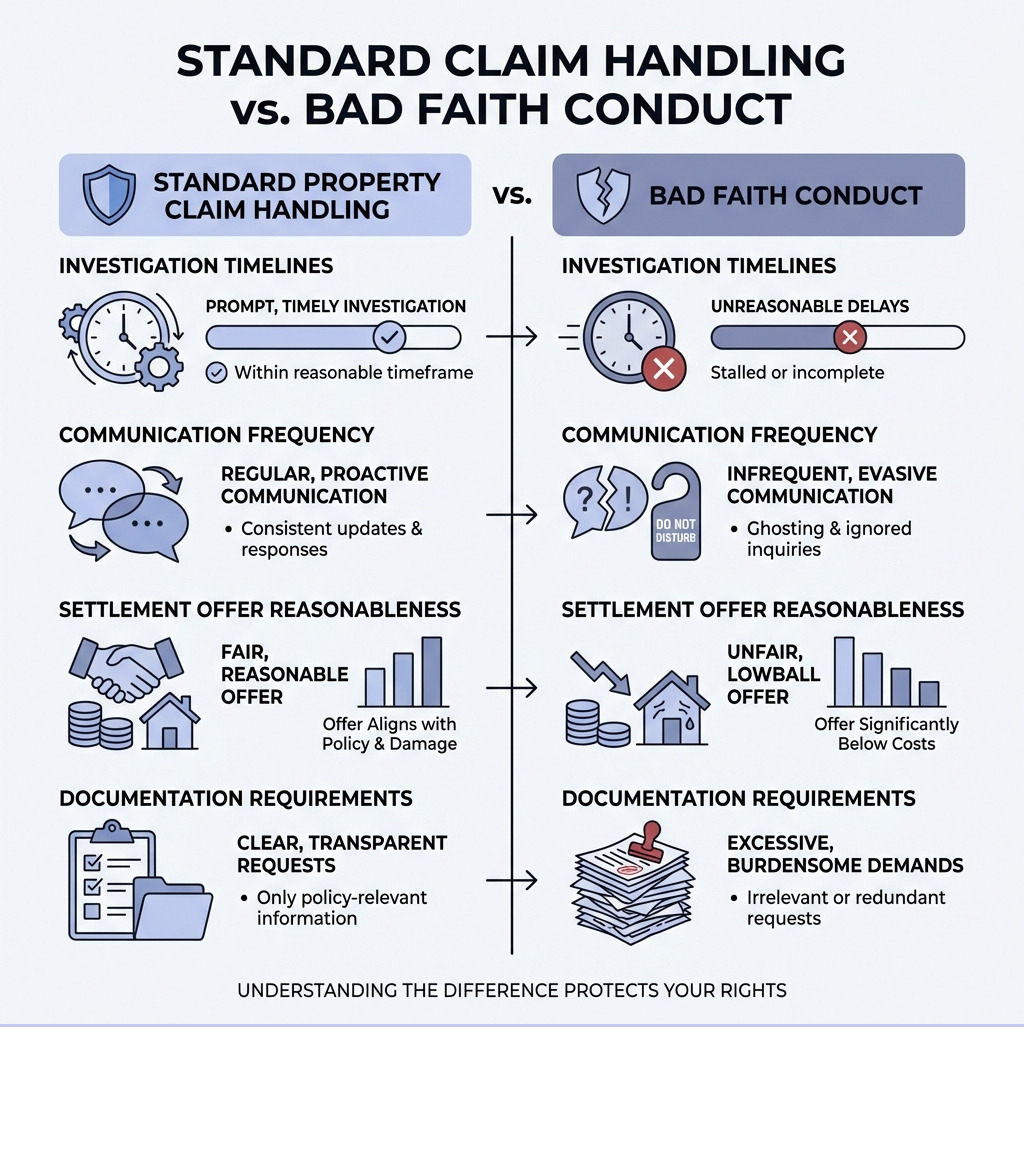
- Undue Delay: Dragging out the process for months without a valid reason, hoping you’ll become desperate for any amount of money.
- Inadequate Investigation: Failing to send a qualified professional to inspect the damage or conducting a “drive-by” inspection that ignores hidden structural issues.
- Lowball Settlements: Offering an amount that is objectively inconsistent with the actual repair costs, often based on biased software or outdated pricing.
- Misrepresenting Policy Language: Telling you something isn’t covered when the fine print clearly says it is.
Recognizing a First-Party Bad Faith Insurance Claim
A bad faith insurance claim in a first-party context often feels like a brick wall. You provide the evidence, but the insurer refuses to communicate. They might set arbitrary deadlines for you to provide documents while taking weeks to respond to your emails. If an insurer refuses to reconsider a denial even after you provide a second opinion insurance claim from a licensed professional, they may be acting in bad faith.
Red Flags in Property Damage Investigations
One of the biggest red flags is the “paper-only” review. This happens when the insurer’s desk adjuster denies a claim based solely on photos or a report from a biased third-party engineer who never stepped foot on your property. They may also ignore detailed contractor estimates that reflect the true cost of local labor and materials in Arizona. Understanding the home insurance claim investigation process is key to spotting when an insurer is cutting corners.
Proving a Bad Faith Insurance Claim
Proving bad faith is a high legal hurdle. It isn’t enough to show the insurance company was wrong; you must show they were unreasonably wrong. In many jurisdictions, the threshold is “overwhelmingly inadequate” handling. To win a bad faith lawsuit, a policyholder generally must prove:
- The insurer lacked a reasonable basis for denying or delaying the claim.
- The insurer knew or recklessly disregarded the fact that it lacked a reasonable basis.
The Role of Internal Insurer Communications
In litigation, your attorney can gain access to the insurer’s internal “claims diary” and email correspondence through a process called discovery. These documents often reveal the true motive behind a denial. For instance, internal communications might show that an adjuster was pressured to meet a “closing quota” or that the company used incentive programs to reward adjusters who paid out less than the average claim value.
Establishing the “Unreasonable” Standard
Courts look at industry standards to determine what a “reasonable” insurer would have done. This often involves expert testimony from people who understand the complexities of property claims. If the insurer’s actions represent a “marked departure” from standard practices, they are at risk. This is why we often recommend getting a second opinion—it provides the objective evidence needed to challenge the insurer’s narrative.
The Legal Landscape: Damages and Recovery
If you successfully prove a bad faith insurance claim, the financial recovery can be significantly higher than the original policy limit. This is because bad faith is a tort, allowing for “extracontractual” damages.
| Type of Damage | Contract Claim (Standard) | Bad Faith Tort Claim |
|---|---|---|
| Policy Benefits | Paid up to limit | Paid in full |
| Interest | Rarely included | Statutory interest (often 10%+) |
| Attorney Fees | Usually paid by you | Often recoverable from insurer |
| Consequential Losses | Not covered | Recoverable (e.g., lost business income) |
| Emotional Distress | Not available | Recoverable in many states |
| Punitive Damages | Never available | Available for egregious/malicious acts |
Landmark Cases and High Stakes
Statistics show that the threat of bad faith liability is a powerful deterrent. In Whiten v. Pilot Insurance Co., a Canadian case that mirrors U.S. principles, a jury awarded $1 million in punitive damages after an insurer tried to force a family into a low settlement by cuting off their living expenses after a fire. In the U.S., the State Farm v. Campbell case reached the Supreme Court, highlighting how punitive awards are used to punish insurers for “reprehensible” conduct.
Bad Faith Laws in Arizona and Beyond
In Arizona, the Unfair Claims Settlement Practices Act outlines specific behaviors that are prohibited. For example, insurers must acknowledge receipt of a claim within 10 working days and complete their investigation within 30 days of receiving a proof of loss. If you live in Chandler, Goodyear, or Mesa, these state-specific protections are your primary shield. However, keep in mind the statute of limitations; in many states, you only have two years from the date the bad faith occurred to file a lawsuit.
Can an Insured Be Held Liable for Bad Faith?
While the duty of good faith is most often discussed regarding insurers, it is actually a reciprocal duty. Policyholders also have an obligation to be honest. If a homeowner provides fraudulent receipts or intentionally misrepresents the cause of damage, the insurer can use “reverse bad faith” or fraud as a defense. Honesty and thorough documentation are your best protections.
Steps to Take if You Suspect Bad Faith
If you feel like your insurer is “playing dirty,” you need to stop being a passive participant and start building a paper trail.
- Keep a Documentation Log: Note every phone call, the name of the person you spoke with, and what was said.
- Request Everything in Writing: If an adjuster tells you something is excluded, ask them to send the specific policy language via email.
- Submit a Formal Written Demand: Clearly state why you believe the current offer is inadequate and provide supporting evidence (like a public adjuster’s estimate).
- Avoid Common Claim Mistakes: Don’t sign anything you don’t understand, and don’t take “no” for an answer if you have evidence to the contrary.
Working with a Public Adjuster
This is where we come in. A public adjuster is the only professional licensed to represent you, the policyholder. Unlike the insurance company’s adjuster, our loyalty isn’t to the insurer’s bottom line—it’s to yours. We handle the heavy lifting: the inspections, the documentation, and the intense negotiations. We speak the insurer’s language and know exactly how to counter their tactics.
Understand the difference between a public adjuster and an insurance adjuster before you get too deep into the process. At Hudson Douglas, we offer bilingual support in both English and Spanish to ensure all our Arizona neighbors are fully protected.
Protecting Your Rights After a Denial
A denial is not the end of the road. It is often just a starting point for negotiation. By conducting an independent appraisal and carefully reviewing where the marketing promises don’t match the fine print, you can often overturn a wrongful denial.
Frequently Asked Questions about Bad Faith
What is the difference between a mistake and bad faith?
Negligence is a mistake—like an adjuster typing the wrong number into a spreadsheet. Bad faith requires an unreasonable act or a reckless disregard for your rights. If the insurer makes a mistake and fixes it immediately, that’s just business. If they refuse to fix a known error to save money, that’s bad faith.
How long do I have to file a bad faith insurance claim?
This depends on the “statute of limitations” in your state. In Arizona, you generally have two years for tort claims. However, some policies have “suit against us” clauses that may attempt to shorten this window. It is vital to consult with a professional as soon as you suspect foul play.
Can I pursue a bad faith claim if my property claim was eventually paid?
Yes. If the insurer caused you financial harm or emotional distress by unreasonably delaying a payment for two years, the fact that they eventually paid the base amount doesn’t excuse the two years of bad faith conduct. You may still be entitled to interest and consequential damages.
Conclusion
Dealing with property damage is stressful enough without having to fight your own insurance company. When an insurer puts their profits over your recovery, they are violating a sacred trust and the law.
Hudson Douglas Public Adjusters is a family-owned and operated firm with over 40 years of experience helping property owners in Arizona, Nevada, and Utah. From the Valley of the Sun to the Wasatch Front, we take pride in our local roots and our reputation for standing up to big insurance companies. We work solely for you, with no upfront fees—we only receive a 12% fee of the final payout, meaning we are incentivized to get you every penny you deserve.
If your insurer is playing dirty, don’t go it alone. Whether you need help in Phoenix, Tucson, or Las Vegas, our team is available 24/7 to review your claim. Contact our expert team today for a comprehensive claim review and let us help you turn a stressful situation into a successful recovery.