
When a Property Loss Hits Your Business, Who’s Really in Your Corner?
Claim management services exist to guide property owners through one of the most stressful financial events they’ll ever face — a serious loss to their building or business.
But here’s what most business owners don’t realize until it’s too late: not all claim management services work for you.
Quick answer — the main types of claim management services for property owners:
| Service Type | Who They Work For | Your Best Interest? |
|---|---|---|
| Staff adjuster (insurer’s employee) | The insurance company | No |
| Independent adjuster (hired by insurer) | The insurance company | No |
| Third-party administrator (TPA) | The insurer or employer | No |
| Public adjuster | You, the policyholder | Yes |
Insurance companies are large, organized, and experienced at managing claims. Most Arizona business owners are not. That gap — between what an insurer offers and what a policyholder actually deserves — is where real money gets left on the table.
The right claim management support levels that playing field.
At Hudson Douglas Public Adjusters, we’re a family-owned Arizona business that works exclusively for property owners — never for insurers. We handle the documentation, estimation, negotiation, and follow-through so you can focus on keeping your business moving. Our fee is 12% of your final settlement, with nothing out of pocket upfront.
Whether your property suffered fire, water, storm, or structural damage, this guide breaks down your options clearly — so you can make a confident, informed decision.
Understanding Claim Management Services for Property Losses
When your commercial building in Chandler or your retail shop in Paradise Valley suffers severe physical damage, your immediate focus shifts to survival. How do you keep operations running? How do you pay your employees? In the middle of this chaos, you are suddenly forced to navigate a complex, highly technical process: the property insurance claim.
For an insurance carrier, claims management is a corporate function designed to control expenses and limit indemnity payout. But for you, the policyholder, professional claim management services mean something entirely different. They represent a dedicated lifeline of claim preparation, policy interpretation, and advocacy.
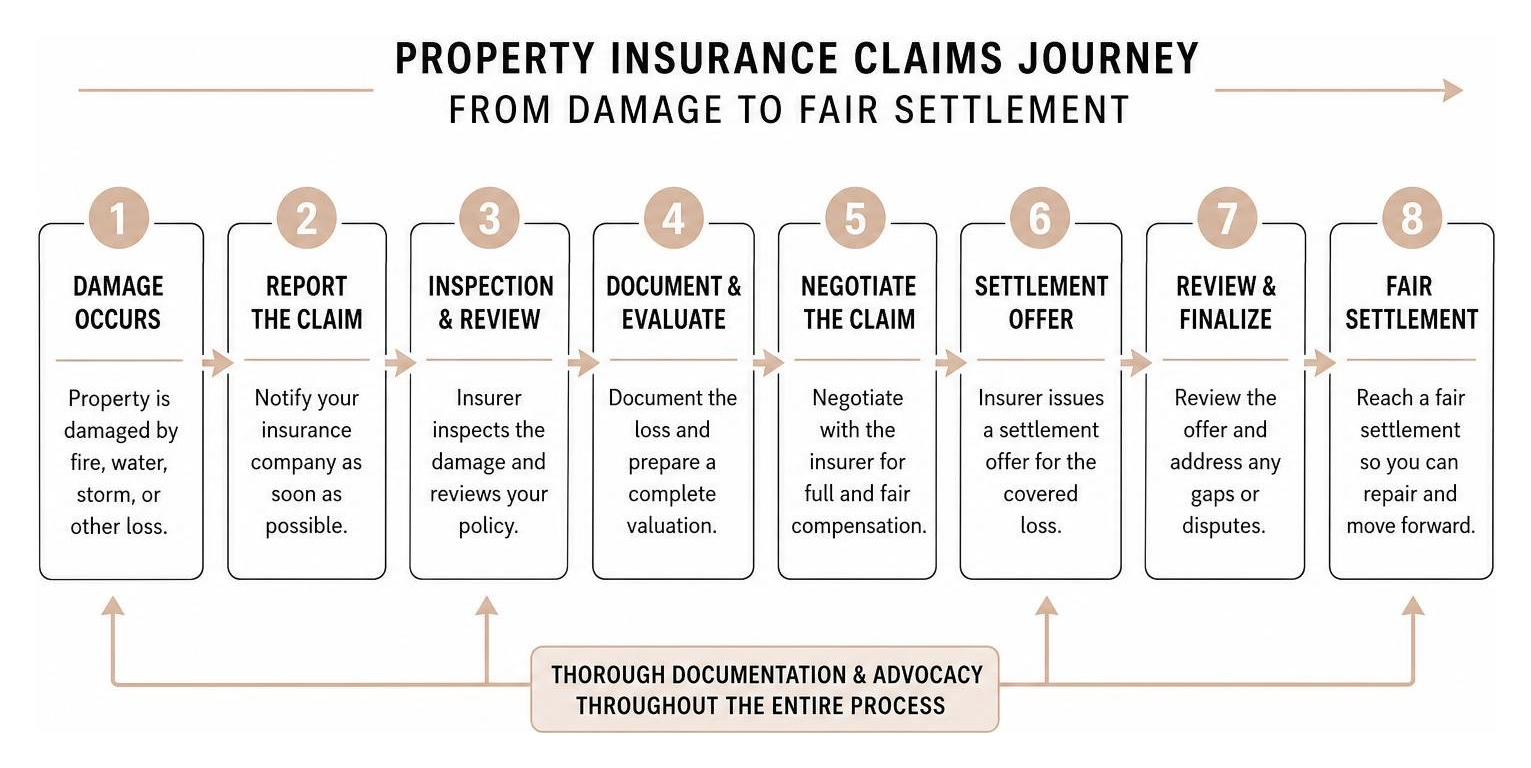
The property claims lifecycle consists of several critical stages:
- First Notice of Loss (FNOL): The initial reporting of the damage to the insurance company. How this is framed can impact your coverage.
- Triage and Policy Review: Analyzing the policy’s fine print, including endorsements, exclusions, and protective safeguard warranties.
- Damage Assessment and Estimation: Conducting a meticulous physical inspection of the structural damage, inventory losses, and business interruption impacts.
- Negotiation and Settlement: Presenting the evidence to the carrier’s representatives and adjusting the claim to secure a fair payout.
To protect your business from the start, it is vital to understand the foundational steps of Don’t Get Damaged Twice: How to File a Property Insurance Claim. For commercial property owners, the stakes are even higher, requiring a deep understanding of complex policy structures, as detailed by the Insurance Information Institute’s guide on commercial property claims.
Without professional claim preparation, a stressed business owner is at a severe disadvantage. When you file a claim, you transition from being an asset (a premium-paying customer) to a liability on the insurance company’s ledger. Their primary goal is to resolve that liability as economically as possible.
Evaluating Your Options: Who Manages Your Business Property Claim?
When a claim is opened, several different adjusters may walk through your door. It is incredibly easy to confuse their roles, but understanding who they represent is the key to protecting your financial recovery.
| Adjuster Type | Employed By | Who Pays Them? | Ultimate Loyalty |
|---|---|---|---|
| Staff Adjuster | The Insurance Company | The Insurance Company | The Insurance Carrier |
| Independent Adjuster | Third-Party Adjusting Firm | The Insurance Company | The Insurance Carrier |
| Public Adjuster | Independent Advocate | You (Contingency Fee) | The Policyholder (You) |
- Staff Adjusters: These are salaried employees of your insurance company. Their training, performance metrics, and corporate loyalty belong strictly to the carrier.
- Independent Adjusters: Despite the friendly name, “independent” adjusters do not work for you. They are third-party contractors hired by the insurance company to handle claims, often during peak storm seasons. Their client is the insurance company, and they are paid to represent the insurer’s interests.
- Third-Party Administrators (TPAs): Large risk management firms often act as TPAs for insurers or self-insured corporations. While they streamline administrative tasks, their primary mandate is to manage the carrier’s Total Cost of Risk (TCOR), not to maximize your individual property settlement.
- Public Adjusters: A public adjuster is the only licensed professional who works exclusively for you, the policyholder.
This clear distinction is why we always urge business owners to read up on Public Adjuster vs. Insurance Adjuster: What’s the Difference? to avoid the common trap of trusting a carrier-paid representative to value your losses.
How Technology is Shaping Modern Claim Management Services
The insurance landscape in July 2026 is highly digitized. Carriers leverage massive tech stacks to process claims rapidly. To keep pace and ensure policyholders are not left behind, professional public adjusters utilize advanced tools to document, measure, and prove property damage with scientific accuracy.
When we inspect a damaged property in Gilbert or Mesa, we don’t just use tape measures and flashlights. We deploy:
- Advanced Thermal Imaging: To detect hidden moisture behind drywall and inside ceiling cavities before mold develops.
- 3D Property Scans: Creating an immutable, digital twin of the damaged space to preserve the exact state of the property for remote adjusters and underwriters.
- Cloud-Based Claim Tracking: Allowing real-time sharing of comprehensive damage evidence with the insurer to minimize administrative delays.
AI and Automation in Claim Management Services
Insurers increasingly use digital platforms to manage claim intake, documentation, evaluation, and communication. Systems such as Guidewire ClaimCenter and DXC Assure Claims help carriers automate portions of the claims lifecycle, while providers such as TP support insurers with technology-enabled claims operations and customer service.
While these technologies improve speed for the insurance company, they often introduce “decision variance” and automated underpayments for the policyholder. Algorithms do not understand the local cost of construction materials in Sedona or the unique architectural challenges of historic buildings in Prescott.
Hudson Douglas uses industry-standard estimating software, to prepare detailed, line-by-line reconstruction estimates. By documenting the property’s actual conditions and applying relevant local pricing, we help ensure the claim evaluation reflects the real scope and cost of the covered loss—not merely the output of an incomplete automated process.
The Human Touch in Complex Claim Management Services
Despite the rise of AI, technology cannot replace human empathy, strategic negotiation, and deep policy knowledge. When a major fire or storm disrupts a local business, the owner is dealing with intense stress and decision fatigue.
Evaluating complex commercial claims requires analyzing the policy’s fine print, assessing business interruption, and projecting lost sales. It requires a human advocate who can sit down with you, validate your frustrations, and stand up to the carrier’s team of forensic accountants. To understand how this human element transforms your recovery, read our guide on Understanding the Role of a Property Damage Adjuster.
Key Challenges in Property Claims and How to Overcome Them
Navigating a commercial property claim in Arizona, Nevada, or Utah comes with unique regional and technical challenges. From monsoon-driven water damage in Queen Creek to winter freeze structural failures along the Utah Wasatch Front, businesses face numerous hurdles:
- Claim Denials and Underpayments: Insurers often point to pre-existing wear and tear or specific policy exclusions to deny coverage.
- Documentation Gaps: Stressed business owners rarely have the time to catalog every damaged item, leading to incomplete claims.
- Code Compliance Upgrades: Rebuilding after a disaster often requires bringing old structures up to modern building codes. If your policy’s “Ordinance or Law” coverage is not negotiated correctly, these massive expenses will come out of your pocket.
- Coinsurance Penalties: Many commercial policies contain a coinsurance clause. If your property is deemed underinsured at the time of the loss, the carrier can penalize your payout significantly.
These challenges are why professional policyholder representation is so critical. By building an airtight, evidence-backed claim package, we eliminate the carrier’s excuses for delays and underpayments. If you are wondering whether professional help is right for your situation, explore Considering a Public Adjuster? Here’s Why You Should.
Frequently Asked Questions About Property Claims
What is the difference between an insurance company adjuster and a public adjuster?
An insurance company adjuster (whether a staff adjuster or an independent contractor) is hired and paid by the insurance carrier. Their legal and financial duty is to protect the insurer’s bottom line.
A public adjuster is hired exclusively by you, the policyholder. We have no conflict of interest because we do not work for insurance companies. Our sole job is to secure the maximum settlement you are legally owed under your policy. To learn more about how this process works, see Adjusting to Loss: How Property Loss Adjusting Works for You.
How do professional claim management services protect a business’s financial recovery?
A serious property loss can decimate a business’s financial performance. Professional claim management protects your recovery by:
- Minimizing Your Total Cost of Risk (TCOR): Ensuring you do not absorb losses that should be covered by your policy.
- Accurately Calculating Business Interruption: Projecting lost sales, continuing expenses, and payroll costs to keep your business solvent while rebuilding.
- Maximizing Settlement Value: In many cases, professional public adjusters help secure settlements that are double or triple the insurer’s initial lowball offer. For emergency planning and recovery resources, business owners can also consult the SBA’s Emergency Preparedness Guide.
Can a general contractor negotiate my commercial property claim?
No. In Arizona, Nevada, and Utah, it is illegal for a general contractor to negotiate insurance policy terms or settle a claim on your behalf. This is legally classified as the Unlicensed Practice of Public Adjusting (UPPA).
While contractors are experts at building, they lack the legal licensing to interpret insurance policy language, analyze exclusions, or negotiate financial settlements. A licensed public adjuster is legally authorized to represent your interests and negotiate directly with your insurer.
Conclusion
When property damage threatens the future of your business, you do not have to face the insurance giant alone. Navigating complex claims requires time, technical expertise, and steady advocacy.
At Hudson Douglas Public Adjusters, we are a family-owned and operated business with over 40 years of combined expertise. We serve commercial property owners and homeowners across Arizona (including Paradise Valley, Gilbert, Queen Creek, Mesa, Chandler, Goodyear, Scottsdale, Sedona, and Flagstaff), Clark County, Nevada, and the Utah Wasatch Front.
We work entirely on a contingency basis: our fee is 12% of the final payout, and you pay absolutely nothing out of pocket. We are available 24/7 and offer fully bilingual English/Spanish support.
Let us handle the stress of the claims process so you can focus on rebuilding your business.
Get help with your property claim from Hudson Douglas Public Adjusters today.