What You Need to Know Before Filing a Slab Leak Claim
Filing a slab leak claim can feel overwhelming — especially when you’re already dealing with damaged floors, rising water bills, and an insurance process that’s hard to understand.
Here’s the quick answer most homeowners need first:
What does homeowners insurance typically cover for a slab leak?
| Coverage Area | Usually Covered? |
|---|---|
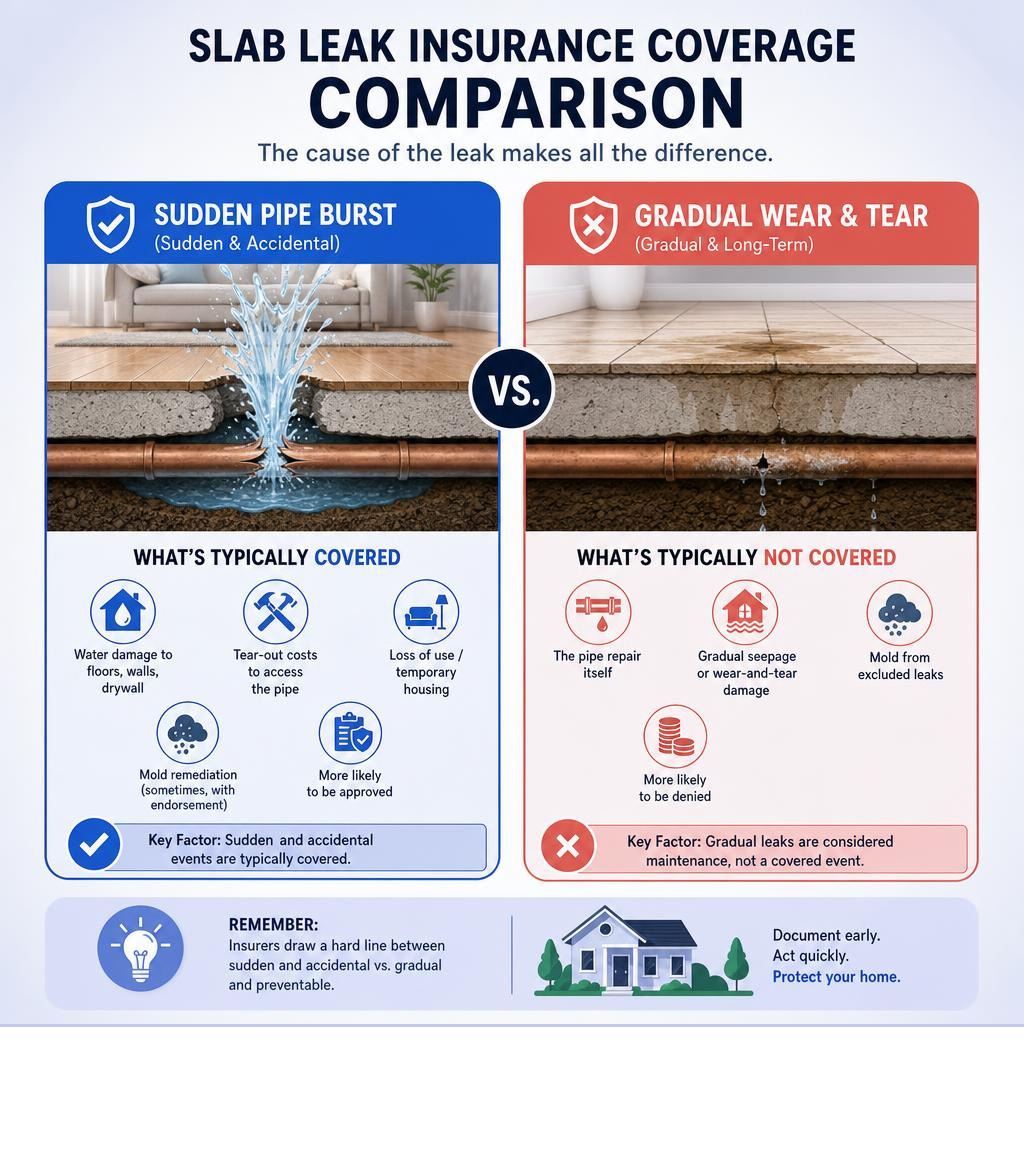
| Water damage to floors, walls, and drywall | Yes — if the leak was sudden and accidental |
| Tear-out costs to access the pipe | Often yes — check your policy |
| The pipe repair itself | Rarely — usually excluded as maintenance |
| Mold remediation from a covered leak | Sometimes — often requires an endorsement |
| Gradual seepage or wear-and-tear damage | No — almost always excluded |
| Loss of use / temporary housing | Yes — if home is uninhabitable |
The single biggest factor in whether your claim is approved or denied: was the leak sudden and accidental, or did it develop slowly over time? Insurers draw a hard line between the two.
Slab leaks are among the most serious and costly plumbing problems a homeowner can face. The average water damage claim costs nearly $14,000 — and slab leak repairs alone can run anywhere from $2,300 for a straightforward fix to well over $6,700 for complex cases. That’s before you factor in flooring replacement, drywall repairs, mold remediation, or temporary housing.
What makes slab leaks especially difficult is that they often go unnoticed for weeks. By the time you see warm spots on your tile or get a water bill that’s jumped 40%, the damage may already be spreading beneath your foundation.
At Hudson Douglas Public Adjusters, we’re a family-owned, Arizona-based team that has helped local homeowners navigate exactly this kind of situation — the kind where the damage is real, the process is confusing, and you’re not sure if your insurer is being straight with you. We work exclusively for policyholders, not insurance companies. And because we’re paid 12% of your settlement only when you get paid, you have no out-of-pocket costs to work with us.
Whether you speak English or Spanish, we’re here to walk through this with you — clearly, honestly, and without pressure.
Slab leak claim terms simplified:
Understanding Slab Leaks: Causes and Warning Signs
To protect your home and your eventual insurance claim, it helps to understand what is happening beneath your feet. A slab leak occurs when the pressurized fresh water lines running beneath your home’s concrete foundation rupture or crack. Unlike a standard wall leak, water escaping under a concrete slab has nowhere to go but up and out, slowly saturating the concrete and eventually invading your living space.
The Culprits Under the Concrete
In Arizona communities like Scottsdale, Mesa, and Queen Creek, several regional factors contribute to slab leaks:
- Copper Pipes and Corrosion: Many homes built in the 1970s, 80s, and 90s utilize copper pipes under the slab. Over time, the chemical reaction between the copper, minerals in Arizona’s hard water, and the surrounding concrete causes the metal to thin and corrode.
- Soil Expansion (Clay Soil): Our desert soil is rich in expansive clay. When clay soil gets wet, it swells; when it dries, it shrinks. This continuous movement shifts the heavy concrete foundation, placing immense stress on the rigid metal pipes buried within or beneath it.
- High Water Pressure: Municipal water systems sometimes deliver water at high pressure, which accelerates wear on joints and bends in your plumbing system.
Spotting the Warning Signs Early
Because the plumbing is buried, you cannot see the leak directly. Instead, you must watch for secondary signs:
- Unexplained High Water Bills: A sudden jump in water consumption without a change in your household habits is often the first indicator.
- Warm Spots on the Floor: If a hot water line under the slab is leaking, you may feel localized warm spots on your tile, laminate, or carpeted floors.
- The Sound of Running Water: Hearing water rushing or dripping when all faucets and appliances are turned off is a classic sign of an active slab leak.
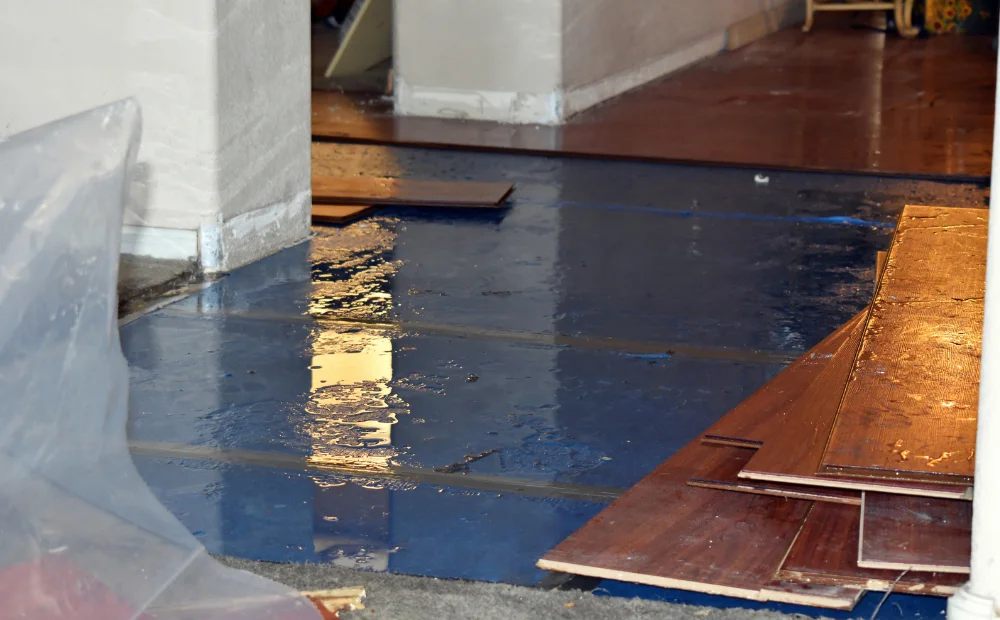
- Damp Flooring or Ruined Baseboards: Water will eventually wick up through the porous concrete, ruining carpet pads, warping hardwood, or causing tile grout to discolor.
If you suspect an issue, scheduling a professional Slab Leak Detection in San Tan Valley or your local Arizona neighborhood is crucial to pinpointing the issue before it causes catastrophic Water Damage to your property.

Navigating Your Slab Leak Claim: What Arizona Homeowners Need to Know
When you discover water damage, your first instinct is likely to call your insurance company. However, navigating a slab leak claim requires a solid understanding of how policies are written and how insurance adjusters evaluate foundation losses.
Standard homeowners insurance policies (such as an HO-3 policy) generally break down slab leak coverage into three distinct parts:
- The Pipe Repair (Rarely Covered): Insurance companies view the plumbing pipe itself as a wear-and-tear item. Unless the pipe burst due to a covered peril (like a sudden freezing event or a localized explosion), the cost to physically repair the broken section of pipe is excluded under the standard maintenance exclusion.
- Tear-Out and Access Costs (Usually Covered): This is where policy language gets critical. To fix a pipe buried under concrete, a plumber must jackhammer through your flooring and foundation. Standard “dwelling coverage” often covers the cost to “access” the leak. This means the insurance company should pay to demolish the concrete to reach the pipe, and subsequently pour new concrete to seal the hole.
- Resulting Water Damage (Usually Covered): If water from the leak ruins your custom cabinets in Gilbert, warps your hardwood floors in Paradise Valley, or destroys your drywall, your policy’s dwelling and personal property coverages should pay to dry out and rebuild those damaged areas—provided the leak was “sudden and accidental.”
To help clarify this distinction, review the table below:
| Damage Category | Standard Policy Treatment | Why? |
|---|---|---|
| Plumber’s pipe patch/solder | Excluded | Considered homeowner maintenance |
| Jackhammering concrete slab | Covered | Necessary to “access” the covered water escape |
| Drying out wet carpets & walls | Covered | Resulting damage from a sudden discharge |
| Replacing continuous tile flooring | Highly Disputed | Insurance often tries to “patch” instead of matching |
| Slow, rotting wood from a 6-month leak | Excluded | Classified as gradual seepage or neglect |
Because insurance policies are packed with confusing terminology, it is easy to get tripped up. For a deeper look into these nuances, read our guide on Why Covered Water Damage Isn’t Always Covered and explore external insights on Is a Slab Leak Covered by Insurance? to prepare yourself for the process.
How to Document Damage for a Successful Slab Leak Claim
The success of your slab leak claim rests entirely on the quality of your documentation. Insurance companies employ forensic adjusters whose job is to find reasons to minimize or deny claims. To protect your rights, you must build a comprehensive, paper-and-photo trail from day one.
- Capture Detailed Photo and Video Evidence: Take high-definition photos and videos of the damage before any demolition begins. Document wet flooring, warped baseboards, and water pooling outside the home. Once the slab is broken open, take close-up photos of the failed section of pipe before the plumber cuts it out.
- Secure a Detailed Plumber’s Report: Do not rely on a handwritten invoice that simply says “repaired leak.” Ask your plumber to write a formal, detailed diagnostic report. This report should specify:
- The results of hydrostatic or pressure testing.
- The exact location and depth of the failure.
- The plumber’s professional opinion on the cause of the break (e.g., a sudden pressure spike or ground movement rather than long-term wear).
- Utilize Moisture Mapping: Professional restoration companies use moisture meters and thermal imaging cameras to map the invisible migration of water behind walls and under flooring. Ensure you receive a copy of this moisture map.
- Address Continuous Flooring Challenges: If your home has continuous tile or hardwood running from the kitchen through the living room, the insurance company is legally obligated in many jurisdictions to restore your home to a “reasonably uniform appearance.” This means they may have to replace the flooring across the entire open area, rather than just patching the jackhammered hole.
For step-by-step instructions on documenting water issues, review our expert Water Damage Insurance Claim Tips.
Why a Slab Leak Claim Often Gets Denied or Underpaid
Slab leak claims are among the most frequently underpaid or denied claims in the property insurance industry. Insurance companies rely on several common strategies to limit their payouts:
- The “Gradual Seepage” Exclusion: If an insurer can argue that the leak was a slow drip that occurred over weeks or months, they will deny the claim under the “wear and tear” or “gradual seepage” exclusion. This is why immediate reporting and professional forensic plumbing reports are so vital.
- Lowball Excavation and Reconstruction Estimates: Insurers often write estimates using generic software that does not reflect actual local labor rates in high-end Arizona communities like Scottsdale or Cave Creek. They may offer a settlement that covers only a fraction of what a licensed contractor charges to safely jackhammer, repair, and restore a concrete slab.
- Ignoring Code Upgrades and Matching Laws: If your home requires specific code upgrades during the repair process, or if your ruined flooring cannot be matched, insurers often “forget” to include these costs in their initial payout offers.
If you find yourself facing a frustrating denial or an offer that won’t cover your repair bills, consult our Denied Water Damage Claim Guide to understand your options for fighting back.
Step-by-Step Guide to Handling a Foundation Water Loss
If you suspect a slab leak in your home, acting quickly and methodically can save you thousands of dollars in out-of-pocket costs and protect your insurance claim from denial.
[Detect & Confirm] --> [Mitigate & Dry] --> [Document & Map] --> [File Claim]
   Find the leak Stop the water Gather evidence Contact advocate
Step 1: Turn Off the Water Supply
If you see active water pooling on your floors or your water meter is spinning rapidly, shut off your main water valve immediately. This prevents further structural damage and demonstrates to your insurance company that you took immediate steps to mitigate the loss.
Step 2: Call a Professional Leak Detection Expert
Do not start jackhammering your floors blindly. Hire a licensed plumber who specializes in non-invasive acoustic and thermal leak detection. They can pinpoint the exact square foot where the pipe has failed, minimizing the amount of concrete demolition required. For homeowners in the East Valley, you can consult this Complete Guide to Slab Leak Detection & Repair in Gilbert AZ for local best practices.
Step 3: Initiate Professional Mitigation (Dry-Out)
Moisture trapped under concrete will vaporize and travel upward, ruining newly installed floors months after the initial repair if not dried properly. Hire a certified water restoration company to set up industrial dehumidifiers and air movers to thoroughly dry the concrete slab and surrounding framing.
Step 4: Contact an Independent Advocate Before Filing
Before calling your insurance company’s claims hotline, consider speaking with a public adjuster. Once a claim is registered in the insurance database, it cannot be erased. A brief consultation can help you understand if the claim is worth filing relative to your deductible, and how to frame the loss honestly and accurately.
To learn more about how claim valuations are calculated, read our guide From Leak to Loot: Your Guide to Water Damage Insurance Payouts.
Frequently Asked Questions About Slab Leaks
Navigating insurance disputes can be incredibly stressful. Here are the answers to some of the most common questions we hear from Arizona property owners:
Does homeowners insurance cover the cost of repairing the pipe itself?
In almost all cases, no. Standard homeowners policies view plumbing pipes as wear-and-tear items, meaning the physical patch or replacement of the pipe is considered basic home maintenance. However, some homeowners carry an optional Service Line Endorsement or utility line coverage that can help pay for the pipe repair itself.
Even without this endorsement, your policy should still cover the expensive “access” costs (demolishing and replacing the concrete slab) and the resulting water damage to your home’s interior.
How do I know if my slab leak is considered sudden and accidental?
A “sudden and accidental” leak is one that happens unexpectedly—such as a copper pipe suddenly splitting due to a pressure spike, ground shift, or localized failure.
In contrast, a leak that has been slowly dripping for months, causing rot, mold, and decaying wood, is considered gradual. Insurance companies often hire forensic engineers to inspect the failed pipe to determine how long it was leaking. Having your own plumber document the sudden nature of the failure is your best defense against a gradual seepage denial.
Can I reopen a denied insurance claim for a slab leak?
Yes. If your claim was denied or underpaid, you do not have to accept the insurance company’s decision as final. Arizona law allows policyholders to submit supplemental claims or request a claim reopening if new evidence of damage is found, or if the original estimate was insufficient to cover the actual cost of repairs.
Working with a licensed public adjuster is often the most effective way to challenge a denial, as we can conduct a comprehensive re-evaluation of your policy and the physical damage. To understand how this process works, read The Ins and Outs of Public Adjusters for Water Damage.
Conclusion
Dealing with a slab leak is stressful enough without having to fight your insurance company for a fair payout. When you file a slab leak claim, the insurer’s adjusters are working hard to protect their company’s bottom line. You deserve an expert in your corner who is dedicated solely to protecting yours.
At Hudson Douglas Public Adjusters, we bring over 40 years of combined property claims expertise to homeowners and commercial property owners across Arizona, Nevada, and Utah. We are a family-owned and operated business, deeply rooted in our local communities. We understand the unique structural challenges of desert homes—from clay soil expansion in Queen Creek to copper pipe corrosion in Scottsdale.
We pride ourselves on providing clear, honest, and compassionate guidance. We are fully bilingual, offering complete support in both English and Spanish to ensure all of our neighbors feel heard and protected.
Our promise is simple: no upfront fees, 24/7 availability, and we only get paid (12% of the settlement) when you get paid. If we don’t win your claim, you don’t owe us a dime.
Don’t let a confusing policy or a lowball estimate stand between you and a fully restored home. Contact us today to Get a Free Water Damage Consultation and let our family help yours get the settlement you truly deserve.