Understanding Arizona Boundary Wall Claims
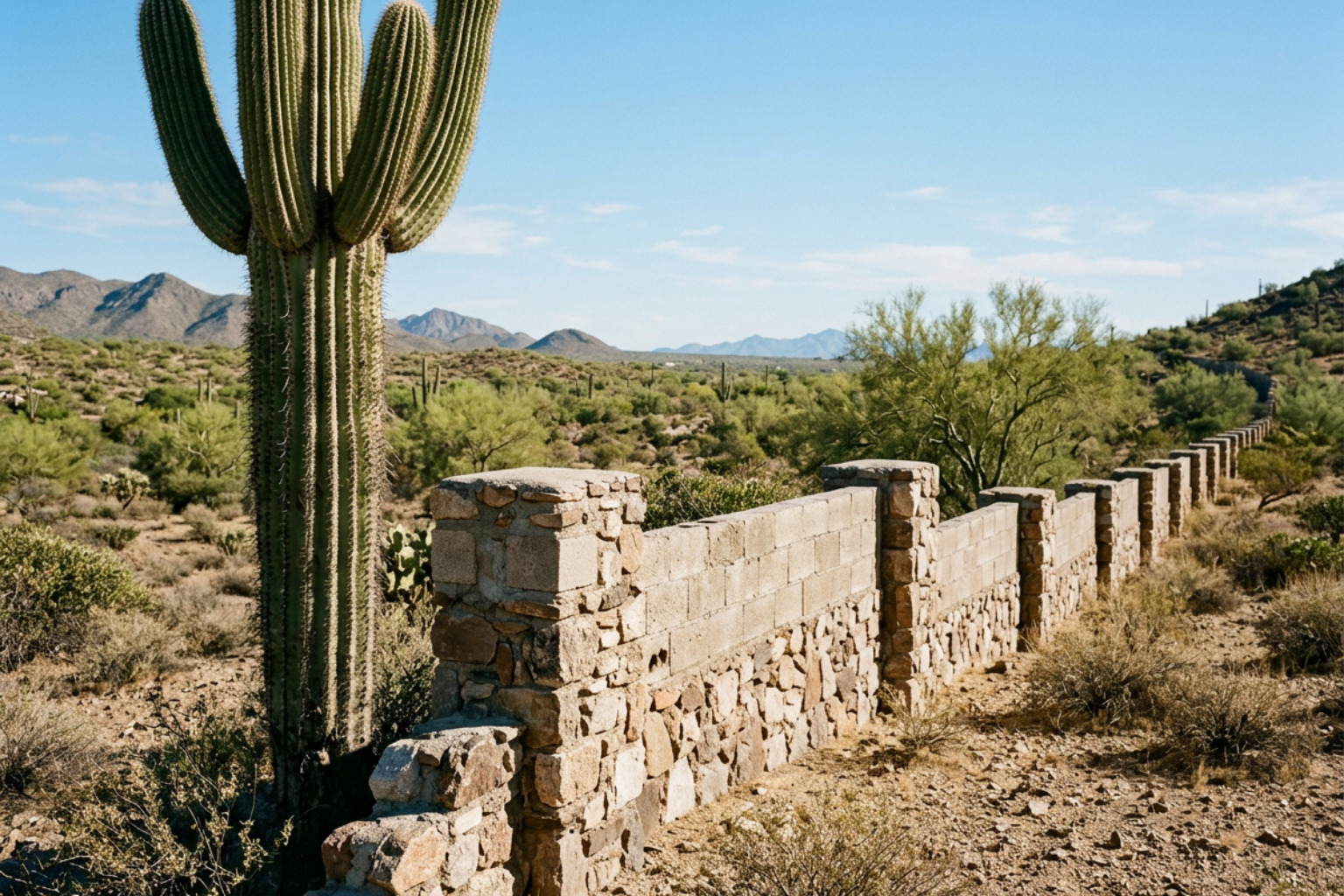
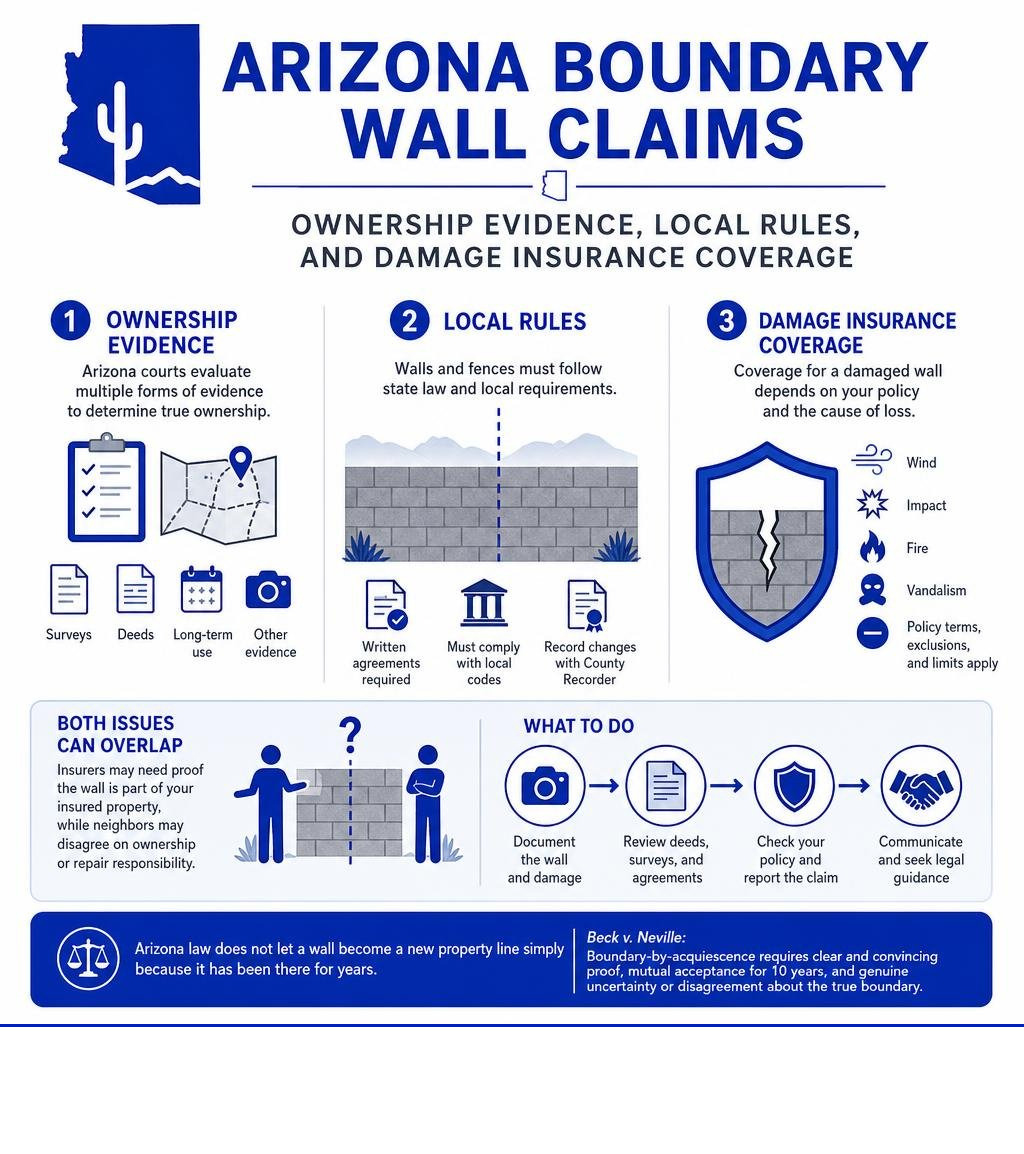
Arizona boundary wall claims can involve two separate issues: who legally owns the land beneath or beside the wall, and whether a residential or commercial property insurance policy covers physical damage to that wall.
- Boundary dispute: A fence, block wall, driveway, or landscaping may sit over the recorded property line. Arizona courts look to surveys, deeds, long-term use, and other evidence.
- Insurance claim: Wind, impact, fire, vandalism, or another covered event may damage a perimeter wall. Coverage depends on the policy, exclusions, limits, and cause of loss.
- Both issues can overlap: An insurer may need proof that the damaged wall was part of your insured property, while a neighbor may disagree about ownership or repair responsibility.
Arizona law does not let a wall become a new property line simply because it has been there for years. In Beck v. Neville, the Arizona Supreme Court confirmed that a boundary-by-acquiescence claim requires clear and convincing proof of a defined line, mutual acceptance of it for 10 years, and genuine uncertainty or disagreement about the true boundary.
That distinction matters after a damaging event. A cracked or fallen block wall can create an insurance claim, but it can also expose an older survey issue, a shared-wall conflict, or an encroachment that must be sorted out separately.
I am Douglas Waldie, and this guide explains the property-line and property-damage questions Arizona owners should understand before deciding what comes next.
Legal Framework of Arizona Boundary Wall Claims
When neighbors evaluate Arizona boundary wall claims, they often discover that property line disputes in our state are governed by a combination of state statutes, common law precedents, and municipal codes. In Arizona, approximately 1 in 4 property deals involves a boundary or easement question that surfaces on the title report. When a physical barrier like a masonry block wall, chain-link fence, or wooden structure sits off the exact deed line, questions about true ownership quickly follow.
Under Arizona Property Line Laws: Fence Disputes & Boundary … , property owners cannot establish a legally binding boundary change through a simple verbal promise or informal “handshake agreement.” State real estate standards mandate that any binding modification to real property lines must be executed in writing and officially recorded with the local County Recorder’s office.
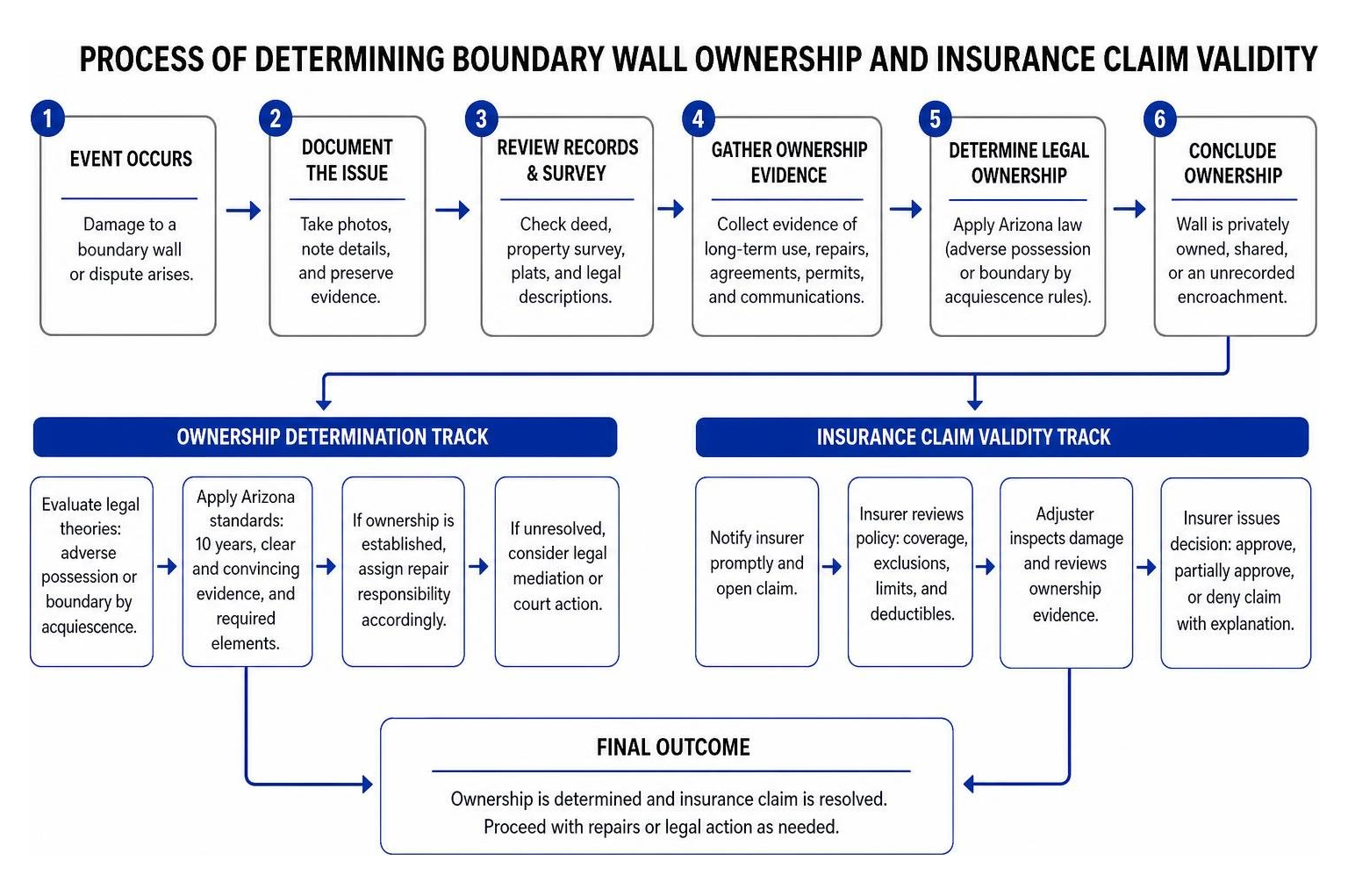
When physical damage occurs to a shared boundary structure, insurance companies and adjusters must verify who holds title to the land underneath the wall. The legal frame of reference dictates whether a wall falls under private ownership, shared ownership, or an unrecorded encroachment.
Adverse Possession vs Boundary by Acquiescence in Arizona Boundary Wall Claims
Property owners frequently confuse adverse possession with boundary by acquiescence when defending or filing Arizona boundary wall claims. While both legal doctrines deal with long-term land occupancy, their statutory requirements and legal theories differ significantly:
- Adverse Possession (A.R.S. § 12-526): To gain legal title to a strip of land through adverse possession in Arizona, a claimant must prove continuous, open, notorious, exclusive, and hostile use of the land for at least 10 years. “Hostile” does not mean angry or violent; rather, it means occupying the property without the true owner’s authorization or permission. For instance, occasionally parking a car on a neighbor’s paved apron does not satisfy the strict continuous and exclusive standard required by law.
- Boundary by Acquiescence: This common law doctrine applies when neighboring landowners tacitly treat a physical marker (such as a concrete block wall) as their legal boundary line over a extended period, even if a formal land survey later shows the wall is set inside one property.
Both legal theories require proof by “clear and convincing evidence”—a higher burden of proof than the simple “preponderance of evidence” standard used in standard civil suits.
The Impact of Beck v. Neville on Arizona Boundary Wall Claims
The legal landscape surrounding boundary claims changed significantly following the landmark decision by the Arizona Supreme Court in Beck v. Neville. In this decision, the Court clarified the exact legal standards necessary to establish a boundary by acquiescence.
Prior to this ruling, property owners often argued that simply erecting a fence and leaving it untouched for 10 years automatically shifted the legal property line. The Supreme Court rejected that passive interpretation by establishing a strict four-part test. To succeed in a boundary by acquiescence claim in Arizona, a party must present clear and convincing evidence of:
- Occupation up to a clearly defined line: A visible, definite physical barrier must exist (such as a masonry wall or fence).
- Mutual acquiescence: Both adjoining landowners must historically accept and treat that physical line as the boundary.
- Continued acquiescence for 10 years: The mutual treatment of the barrier as the property line must continue uninterrupted for a minimum of a decade.
- Uncertainty or a genuine dispute: Crucially, there must have been genuine uncertainty or an actual dispute regarding the true boundary line when the wall was established or treated as the boundary.
If both landowners always knew where the actual surveyed line was, or if the wall was built purely as a fence of convenience inside one owner’s parcel, the wall does not legally alter the property line. Owners facing title clouds or boundary disputes often resolve these matters through a Quiet Title action under A.R.S. § 12-1101, a court proceeding used to establish clear legal title to real property.
Local Ordinances and Municipal Rules Governing Arizona Property Lines
While state statutes establish broad real estate doctrines, local municipal codes heavily regulate physical wall construction, height limits, setbacks, and maintenance duties across Arizona. For example, in Mohave County communities like Lake Havasu City, Bullhead City, and Kingman, reports of neighbors building tall, view-blocking structures—commonly called “spite fences”—increased by 20% in recent years.
Municipalities address these conflicts by enforcing strict zoning and building safety regulations:
- Paradise Valley: Local guidelines on a Fence/Wall on Common Property Line outline shared maintenance expectations and clear structural setback rules for residential properties.
- Scottsdale: Specific provisions regarding Walls and Fences | City of Scottsdale dictate maximum height allowances, decorative building materials, and site-distance clearances near driveways and streets.
- Pool Safety Enclosures: Statewide health and safety codes strictly require compliant perimeter fencing or barrier walls around residential swimming pools to protect children and prevent accidental drownings.
Local Code Compliance Across Arizona Cities

Different municipalities enforce distinct building codes regarding residential perimeter walls. Understanding these rules is essential when repairing or replacing a compromised perimeter wall:
- Queen Creek: Property owners must adhere to dedicated Fencing Requirements | Queen Creek, AZ covering maximum wall heights (typically 6 feet in residential rear yards) and specific construction permits prior to breaking ground.
- Gilbert & Goodyear: Code compliance departments mandate that common property line walls meet local structural engineering standards to withstand intense desert windstorms and soil erosion.
- Mesa: Regulations strictly limit unauthorized modifications or physical attachments to city-owned property or public rights-of-way.
When severe monsoon winds knock down a party wall built along a common lot line, local municipal codes frequently influence how repair costs and permits are allocated between neighbors.
Impact of Survey Inaccuracies and Missing Boundary Markers
A primary cause of Arizona boundary wall claims is historical survey inaccuracies. Land surveys conducted prior to 1990 have an estimated 15% error rate due to the older measurement tools, manual transits, and physical chains used by earlier surveyors.
Over decades, intense desert winds, land grading, and soil movement have buried or erased physical monument markers, such as wooden stakes or metal rebar pins. While parcel maps on County Assessor websites provide helpful general visual references for property tax assessments, they are not legally binding boundary determinations. Only a fresh, professional land survey conducted by a licensed Arizona Registered Land Surveyor provides definitive proof of property lines in court or during an insurance investigation.
Commercial and Residential Property Boundaries Near Federal and Tribal Easements
In Arizona, boundary wall claims and physical property damage issues do not occur only between neighboring residential suburban lots. Complex claims also arise when private residential properties or commercial developments border large-scale infrastructure, federal easements, or sovereign tribal lands.
For instance, when commercial storage facilities or residential master-planned communities border federal rights-of-way or tribal reservation boundaries, physical damage to perimeter masonry walls from storm runoff, construction activity, or earth movement can spark detailed boundary and insurance coverage disputes. Legal precedent surrounding federal infrastructure projects—such as decisions reviewed in Federal Judge Rejects Tohono O’odham Nation’s Bid to Halt Border Wall Construction – Native News Online —demonstrates how historical federal land designations and easements interact with surrounding private residential and commercial property rights.
Interplay Between Public Easements and Private Property Damage Claims
When physical damage affects a boundary wall situated between private residential or commercial real estate and adjacent federal, state, or tribal land, property owners must navigate unique property line and insurance framework rules:
- The Roosevelt Reservation Easement: President Theodore Roosevelt set aside a 60-foot-wide federal strip along public land boundaries for national security and border surveillance. When commercial or residential structures abut this strip, property owners must verify whether damaged block walls sit on private residential or commercial property or within the federal easement, which impacts insurance recovery for structural repairs.
- Statutory Boundaries and Easement Rights (25 U.S.C. § 398d): Under federal law, establishing security barriers or infrastructure along federal easements does not automatically alter surrounding private residential or commercial boundary lines. As highlighted in legal reporting like Judge won’t block border wall through AZ tribal reservation , physical construction within defined easements leaves underlying land titles intact.
- Sovereign Immunity and Commercial/Residential Claims: If public or federal construction activity causes vibration or structural damage to an adjacent commercial building’s perimeter wall or a residential homeowner’s fence, claims against public entities face sovereign immunity hurdles. In contrast, physical damage caused by covered storm perils remains claimable under the commercial or residential property insurance policy covering the private lot.
Understanding whether a damaged masonry wall is located on private residential property, commercial land, or an adjacent government easement is essential for securing proper insurance coverage and obtaining full financial recovery for necessary repairs.
Landowner Action Steps and Physical Damage Insurance Coverage
When faced with property line encroachments or sudden physical damage to a perimeter wall, property owners must take systematic steps to preserve their legal rights and secure financial recovery.
Whether dealing with a neighbor whose newly poured patio encroaches two feet over your boundary line or a severe monsoon storm that collapses a 50-foot section of your cinder block perimeter wall, taking prompt action is essential. Property owners dealing with complex physical structural damage frequently seek a formal Property Loss Claim evaluation to document the full scope of physical destruction before filing with their insurer.
Working with an experienced Public Adjuster for Homeowners ensures that property owners receive expert guidance when navigating confusing insurance paperwork, scope-of-loss estimates, and policy language.
Steps to Protect Property Boundaries Against Encroachment
If you suspect a neighboring structure, driveway, or wall encroaches on your land, following a structured process helps protect your title and property value:

- Obtain a Professional Boundary Survey: Hire a licensed Arizona Registered Land Surveyor to locate official property corners, rebar markers, and exact lot dimensions. Never rely solely on fence lines or online parcel maps.
- Review Your Title Insurance Policy: Check your title policy for existing easements, recorded covenants, or boundary endorsements that were documented when you purchased the home.
- Establish Written Agreements: If you choose to grant a neighbor permission to maintain a temporary fence inside your property line, formalize the arrangement in a written, revocable license agreement recorded with the County Recorder. This prevents the neighbor from later asserting a 10-year adverse possession or acquiescence claim.
- Request an Independent Claims Review: If an insurer denies or reduces a claim for physical boundary wall damage caused by storm or impact, requesting a Second Opinion Insurance Claim assessment helps verify whether the loss was properly calculated under your policy provisions.
Managing Insurance Claims for Physical Boundary Wall Loss
When windstorms, vehicular impacts, or falling trees cause severe physical damage to a boundary wall, property owners turn to their homeowners or commercial property insurance policies for financial recovery. However, boundary wall claims present unique adjusting challenges:
- Coverage A vs. Coverage B: On residential policies, perimeter block walls set away from the primary house are typically classified under “Coverage B – Other Structures.” Coverage B limits are usually set at a fixed percentage (e.g., 10% or 20%) of the primary dwelling’s coverage limit.
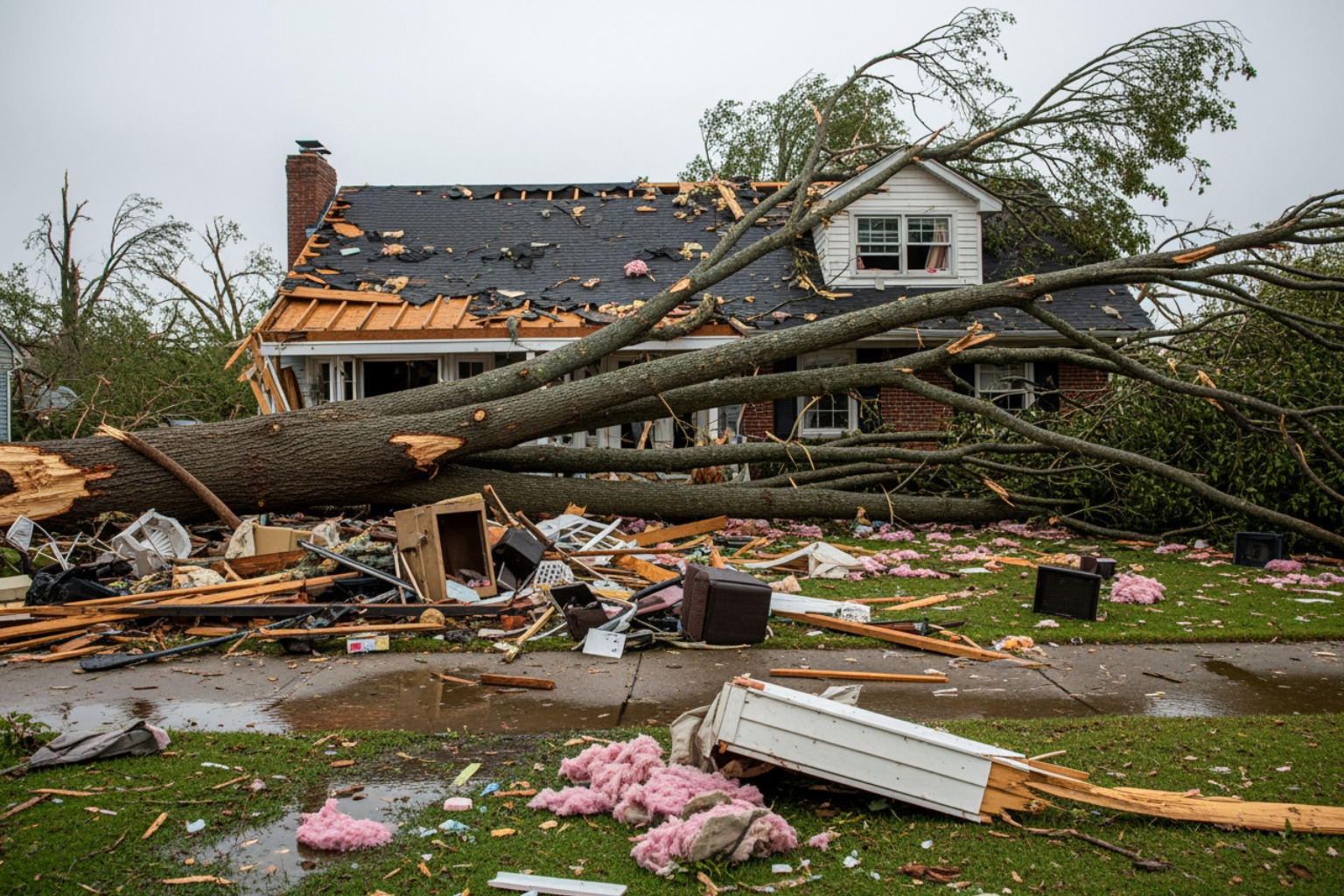
- Cause of Loss Verification: Insurance policies cover physical damage resulting from specific covered events (or causes of loss), such as windstorms, fallen trees, or vehicle impacts. They generally exclude damage caused by earth movement, long-term soil settlement, poor construction, or lack of routine maintenance.
- Shared Wall Cost Allocation: If a party wall sitting precisely on the property line breaks during a microburst, insurance companies must evaluate joint ownership rights and determine whether both neighbors’ policies should contribute to the replacement cost.
In many cases, insurance companies issue initial repair estimates that fail to account for proper footings, rebar reinforcement, local permit fees, or municipal block-matching mandates. Recognizing the clear Signs Insurance Company Underpaid your loss—such as an adjuster using outdated labor rates or omitting required demolition and debris removal costs—is vital to securing a fair payout.
As policyholder advocates, we assist property owners in reviewing their claim documentation, preparing detailed scope-of-loss estimates, and negotiating directly with insurance companies. We work exclusively for property owners—never for insurance carriers—and charge no upfront costs, taking a fee of 12% of the final claim payout.
Frequently Asked Questions About Arizona Boundary Lines
How long does an Arizona boundary line dispute typically take to resolve?
The timeline for resolving a property boundary dispute in Arizona depends heavily on the chosen path of resolution:
- Informal Mediation & Recorded Agreements: If neighboring property owners reach a mutual consensus using a fresh professional survey, drafting and recording an official lot line adjustment or written easement typically takes 30 to 60 days.
- Formal Court Litigation (Quiet Title Actions): If neighbors cannot agree and initiate a Quiet Title lawsuit under A.R.S. § 12-1101 to establish legal ownership, court proceedings, discovery, and trial can take anywhere from 12 to 24 months depending on local Superior Court schedules in counties like Maricopa, Pima, or Mohave.
What evidence is required to prove boundary by acquiescence in Arizona?
Following the Supreme Court precedent in Beck v. Neville, proving boundary by acquiescence in Arizona requires clear and convincing evidence satisfying four specific criteria:
- A Visible Physical Line: Proof of a concrete wall, fence, or distinct landmark occupied up to a specific boundary line.
- Mutual Acceptance: Historical evidence showing that both adjacent property owners mutually treated and accepted that physical line as their legal boundary.
- 10-Year Continuity: Documented proof that this mutual acceptance continued without interruption for at least 10 consecutive years.
- Historical Dispute or Uncertainty: Evidence establishing that the true deed boundary was genuinely uncertain, unknown, or disputed at the time the boundary line was established or treated as the property edge.
Does property insurance cover physical damage to perimeter boundary walls?
Yes, standard residential and commercial property insurance policies generally cover physical damage to perimeter boundary walls, subject to specific policy terms and exclusions:
- Covered Perils: Physical loss caused by severe windstorms, monsoons, lightning, vehicle impacts, explosion, or falling trees is typically covered under the “Other Structures” portion of your property policy.
- Common Exclusions: Policies typically exclude wall damage resulting from gradual soil movement, poor foundation engineering, water seepage, earth movement/landslides, wear and tear, or intentional damage.
- Shared Walls: If a wall sits directly on a shared property line, insurance adjusters evaluate ownership deeds and coordinate with both property owners’ carriers to distribute repair funds fairly.
Conclusion
Navigating Arizona boundary wall claims requires a clear understanding of property boundary laws and property insurance coverage rules. Whether you are dealing with a historic lot line survey discrepancy or managing a complex property insurance claim for a storm-damaged block wall, having experienced professionals on your side makes all the difference.
We at Hudson Douglas Public Adjusters are a family-owned and operated, locally based Arizona business serving residential homeowners and commercial property owners across Paradise Valley, Queen Creek, Gilbert, Scottsdale, Chandler, Goodyear, Mesa, San Tan Valley, Cave Creek, Prescott, Flagstaff, and communities statewide.
We represent policyholders exclusively—never insurance companies. Our goal is to reduce your stress, eliminate decision fatigue, and ensure your property loss claim is fully documented, properly estimated, and fairly settled. With over 40 years of combined industry expertise, 24/7 availability, and bilingual English/Spanish support, we stand ready to protect your property investment.
If your residential or commercial boundary wall has suffered physical damage, contact us today for a free claim consultation. We receive 12% of the final claim payout, meaning our clients pay no out-of-pocket costs for our advocacy services.