Understanding Property Insurance Claim Estimates and How They Work
To get an accurate insurance claim estimate quickly after property damage, immediately provide your adjuster with organized, date-stamped pre-loss photos, detailed room measurements, recent upgrade receipts, and an itemized contractor repair bid. Presenting complete documentation upfront prevents inspection delays, minimizes back-and-forth requests, and helps ensure your insurer’s scope reflects true local labor and material costs from the start.
An insurance claim estimate is an itemized breakdown detailing the specific scope of work, labor rates, and material costs required to restore your damaged structure to its pre-loss condition. Rather than presenting a simple lump-sum figure, a proper estimate functions as an architectural and financial blueprint of your loss, categorizing construction methodology room by room—from initial tear-out to final finishes.
What Is Included in Initial Insurance Claim Estimates?
A comprehensive initial estimate covers every phase of physical remediation.
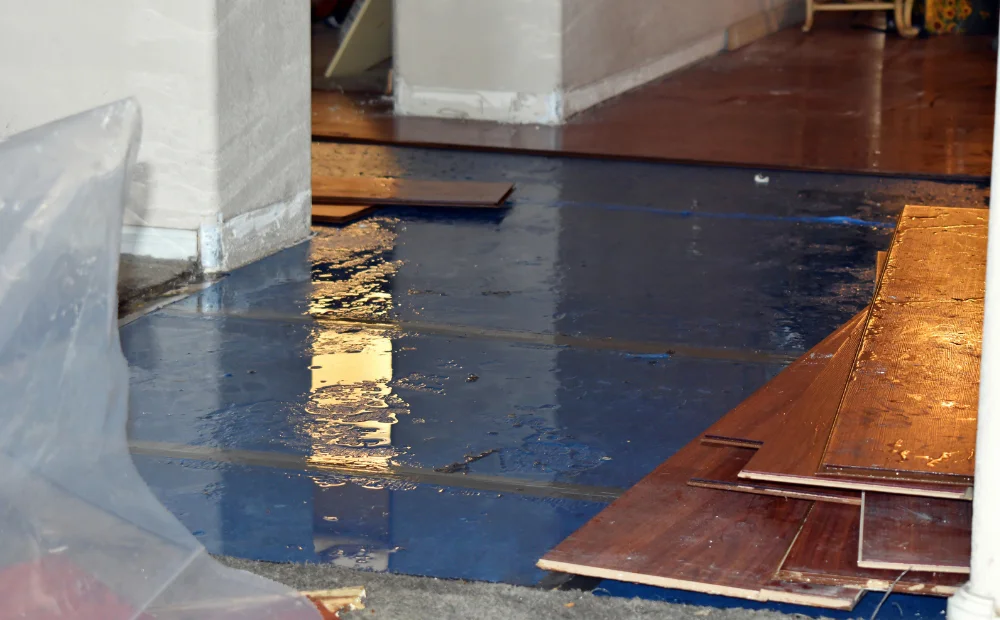
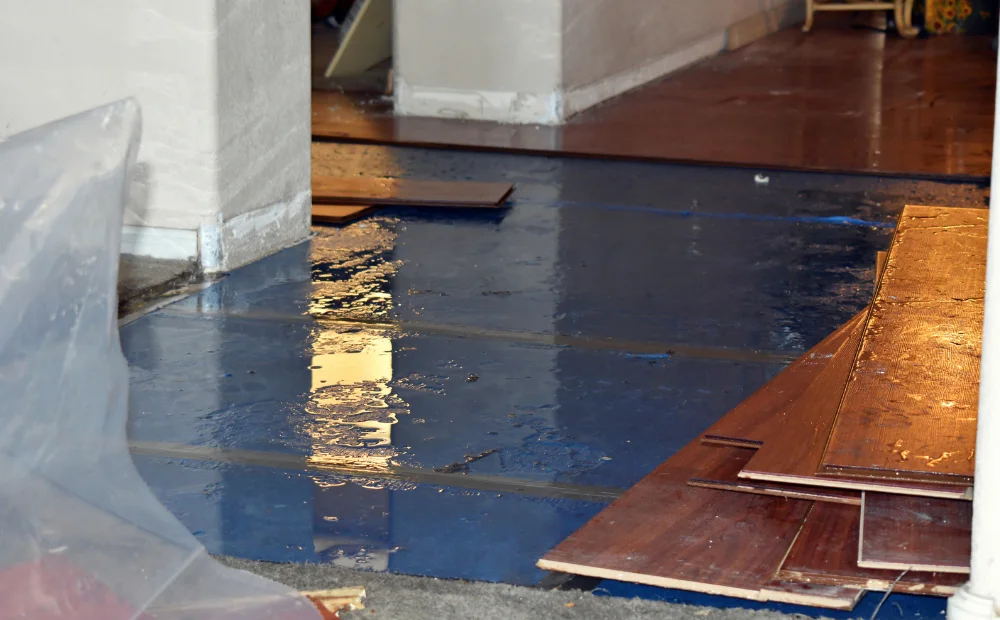
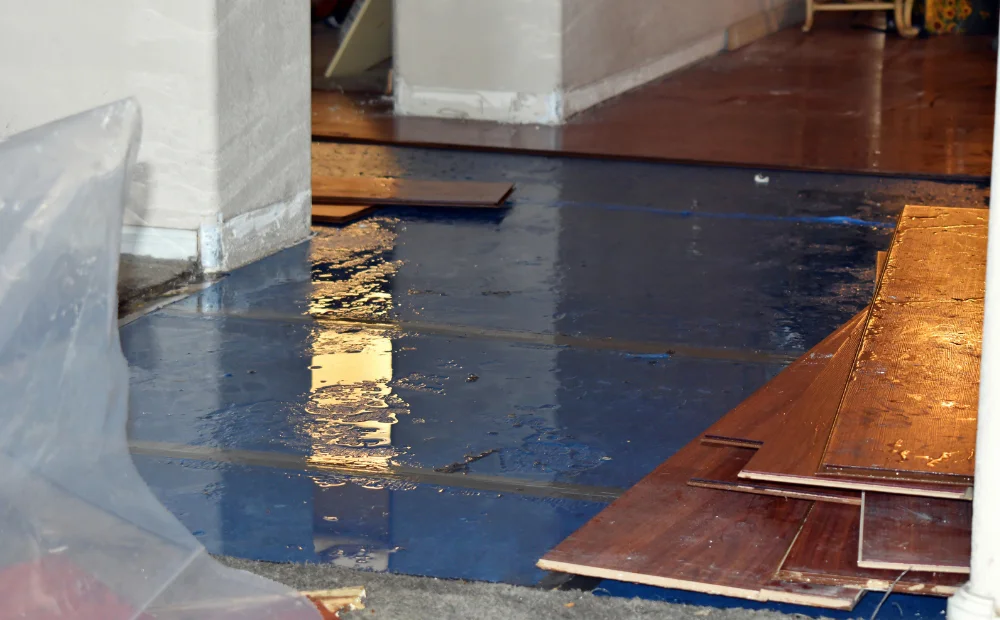
- Demolition and Debris Removal: The physical removal and disposal of compromised drywall, buckled flooring, charred framing, or waterlogged insulation.
- Remediation and Drying: Specialty services such as commercial dehumidification and antimicrobial treatments following events like a burst pipe insurance claim.
- Structural Repairs and Framing: Rebuilding load-bearing components, roof trusses, subflooring, and wall studs.
- Finishes and Mechanical Systems: Hanging new sheetrock, tape and texture, painting, electrical rewiring, plumbing fixture replacement, and baseboard installation.
The Role of Xactimate and Unit Pricing in Property Scopes
Most insurance carrier adjusters write their scopes using specialized software called Xactimate. This platform relies on localized unit pricing databases that update monthly. Every specific action—such as pulling up a square foot of tile or installing a linear foot of crown molding—has an assigned price list code that factors in local labor and supply costs.
While unit pricing standardizes estimation, it frequently misses unique architectural finishes, custom carpentry, or market-driven labor spikes. If an adjuster selects an entry-level grade for your custom cabinetry or misses the specialized scaffolding needed for high ceilings, the entire valuation suffers.
How to Expedite and Review Your Property Loss Scope
To secure an accurate scope quickly, preparation is essential. The speed and quality of your payout depend heavily on the clarity of your supporting claim documentation. Providing organized, date-stamped records eliminates back-and-forth inquiries and fast-tracks the review process.
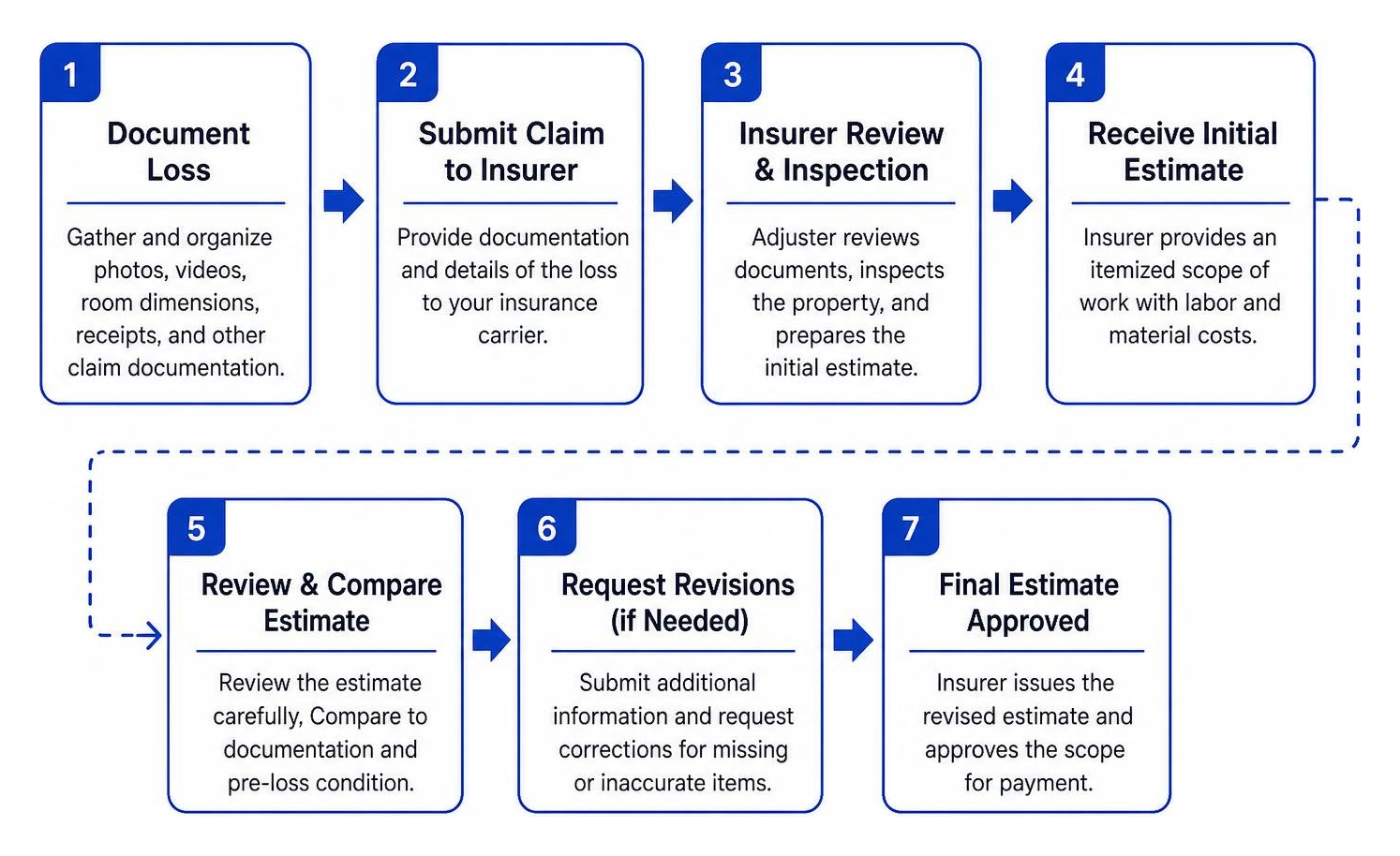
Documenting Pre-Loss Condition and Room Dimensions Accurately
Adjusters are often under pressure to close files quickly, leading to basic mathematical mistakes on room sketches. Precision matters: if a room dimension is underestimated by only one foot on each wall, the calculated area can be off by up to 16%. That single dimensional error cascades across your entire claim, artificially shrinking the budget for sheetrock, paint, baseboards, floor coverings, and electrical rough-ins.
To prove the pre-loss condition and accurate scale of your property, gather:
- Real estate MLS listings featuring wide-angle photos and floor plans.
- Municipal building permits and architectural blueprints.
- Invoices, material receipts, and maintenance logs for recent upgrades.
- Clear photographic evidence documenting the onset of localized damage, such as dishwasher leak damage beneath kitchen cabinets.
Key Factors That Reduce Insurance Claim Estimates and Payouts
The number at the bottom of the page is rarely what is deposited into your bank account immediately. Carriers apply specific financial deductions based on your policy terms.
| Term | What It Means | Impact on Payout |
|---|---|---|
| Replacement Cost Value (RCV) | The full cost to repair or replace the damaged property using modern materials at current prices. | Represents the total potential claim value before deductions. |
| Actual Cash Value (ACV) | The value of the property at the time of loss, calculated as RCV minus physical depreciation. | This is the initial payment issued by the carrier. |
| Recoverable Depreciation | The withheld depreciation amount that you can claim once physical repairs are completed. | Paid as a second check after submitting contractor proof of completion. |
| Non-Recoverable Depreciation | Depreciation withheld permanently due to specific ACV-only policy endorsements or material types. | Represents out-of-pocket loss that cannot be reclaimed. |
| Policy Deductible | The initial dollar amount the policyholder is responsible for paying out of pocket. | Subtracted directly from the net settlement check. |
How the Supplement Process Bridges the Gap on Underpaid Claims
Receiving an initial loss summary that feels inadequate is common. On moderate-to-severe property losses, the final approved repair cost routinely lands 20% to 40% above the insurer’s opening estimate. The mechanism designed to correct these initial shortfalls is the supplement process.
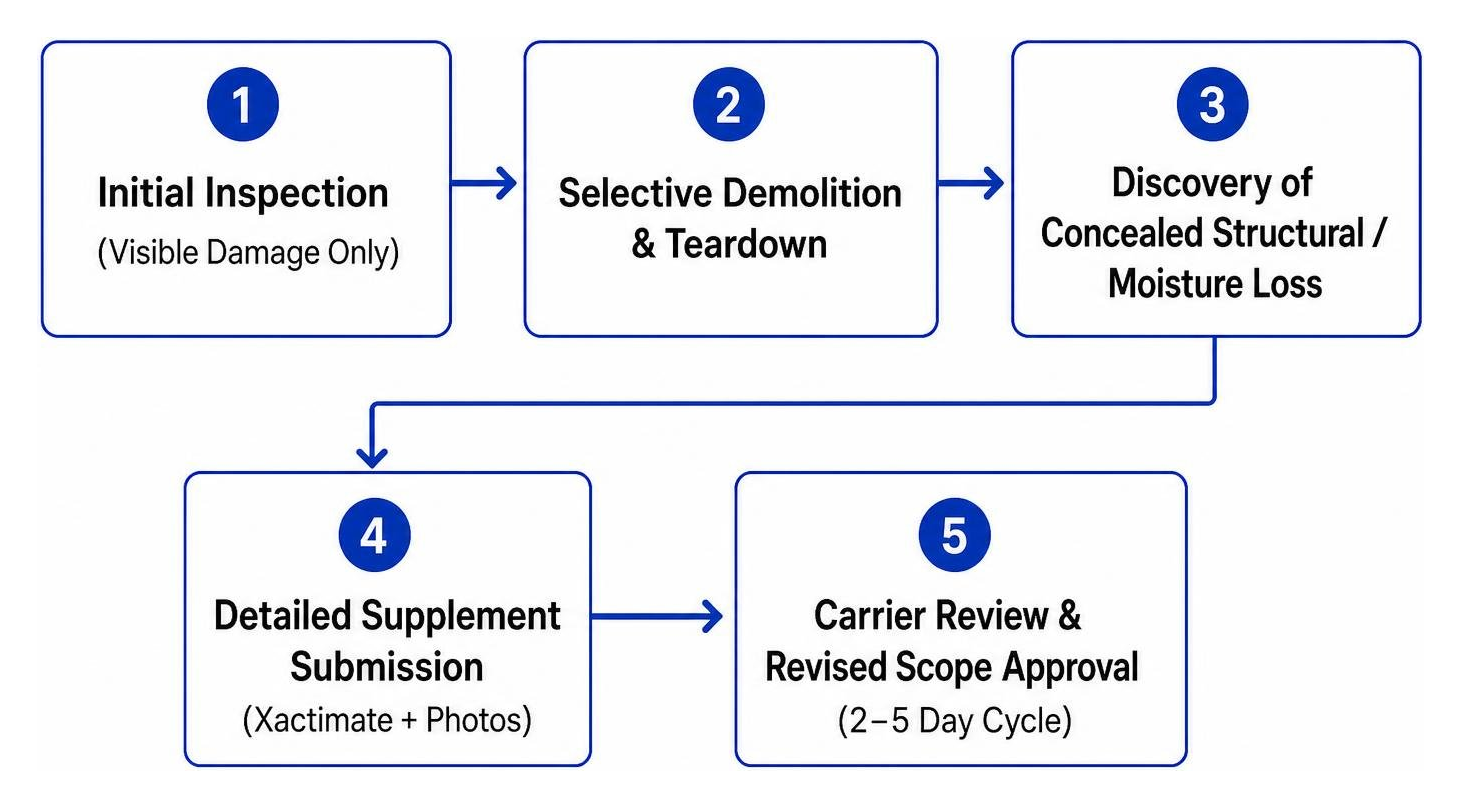
A supplement is a formal, itemized request submitted to the insurer for additional funds, labor hours, or materials when hidden damage is discovered or when initial unit costs prove insufficient.
Why Initial Estimates Fall 20% to 40% Short of Real Repair Costs
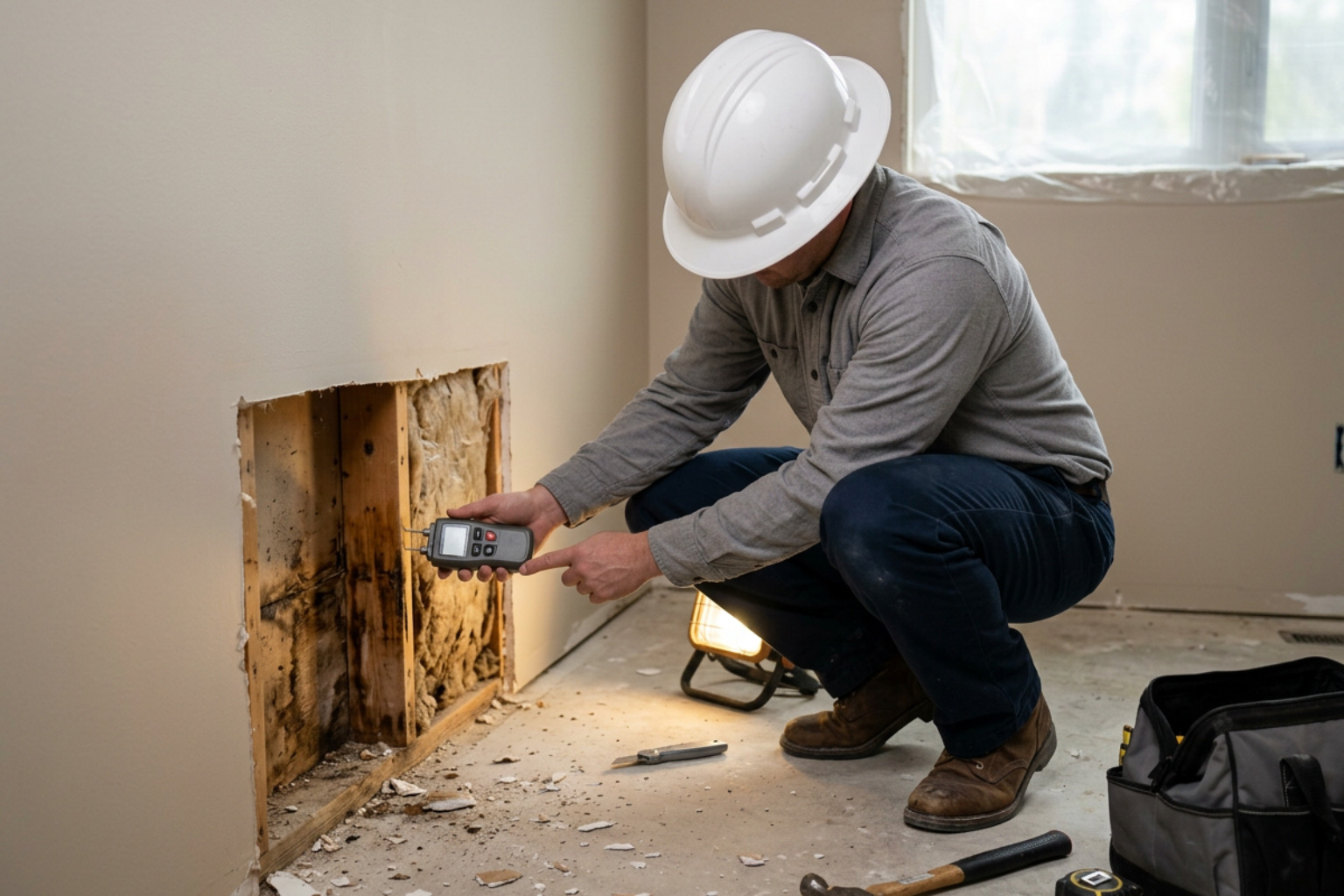
Initial adjuster visits often capture only what is visible on the surface. When physical teardown begins, contractors uncover hidden rot, damaged subflooring, or unaddressed moisture migration. Each supplement cycle (documenting the condition, submitting line items, and awaiting carrier approval) typically adds 2 to 5 business days to the restoration timeline.
Failing to document these hidden issues properly can lead to an unexpected water damage claim denial for the newly uncovered areas.
Navigating Missing Scope, Overhead, and Contractor Profit
In addition to physical repairs, complex projects requiring general contractors must account for soft costs, architectural engineering fees, permitting expenses, and General Contractor Overhead and Profit (OH&P).
A contractor’s office overhead and profit generally total around 20% for a residential restoration project. Insurers may omit OH&P on initial estimates by claiming the job does not involve enough distinct trades. Whether dealing with complex framing or the intricate multi-room remediation required during smoke damage claims, ensuring OH&P and permitting fees are included is vital for hiring qualified builders.
Your Rights and Options When Property Estimates Fall Short
Policyholders have clear rights and dispute avenues under state insurance regulations when an insurer’s estimate fails to reflect real-world construction costs.

Invoking Policy Appraisal Clauses and Escalation Paths
If your carrier refuses to approve necessary repair line items or significantly underprices local labor, you are not forced to accept their evaluation. If you are struggling with why insurance is not paying water claims or structural repairs at realistic market rates, review these standard dispute paths:
- Formal Re-Inspection: Request that the carrier send a senior field adjuster to meet your contractor on-site for a joint review.
- Policy Appraisal Clause: Most residential and commercial property policies contain an appraisal provision. When invoked, each party hires an independent appraiser. The two appraisers select a neutral umpire to resolve differences, creating a binding valuation of the loss without expensive court litigation.
- State Regulatory Inquiries: File an administrative complaint with your state’s Department of Insurance if the insurer ignores statutory communication deadlines or engages in unfair settlement practices.
Partnering with a Licensed Property Damage Representative
Navigating building codes, line-item pricing, and scope negotiations can become overwhelming. Understanding the distinction in public adjuster vs insurance adjuster differences is helpful: staff adjusters work for the carrier’s financial interest, whereas public adjusters work exclusively for you.
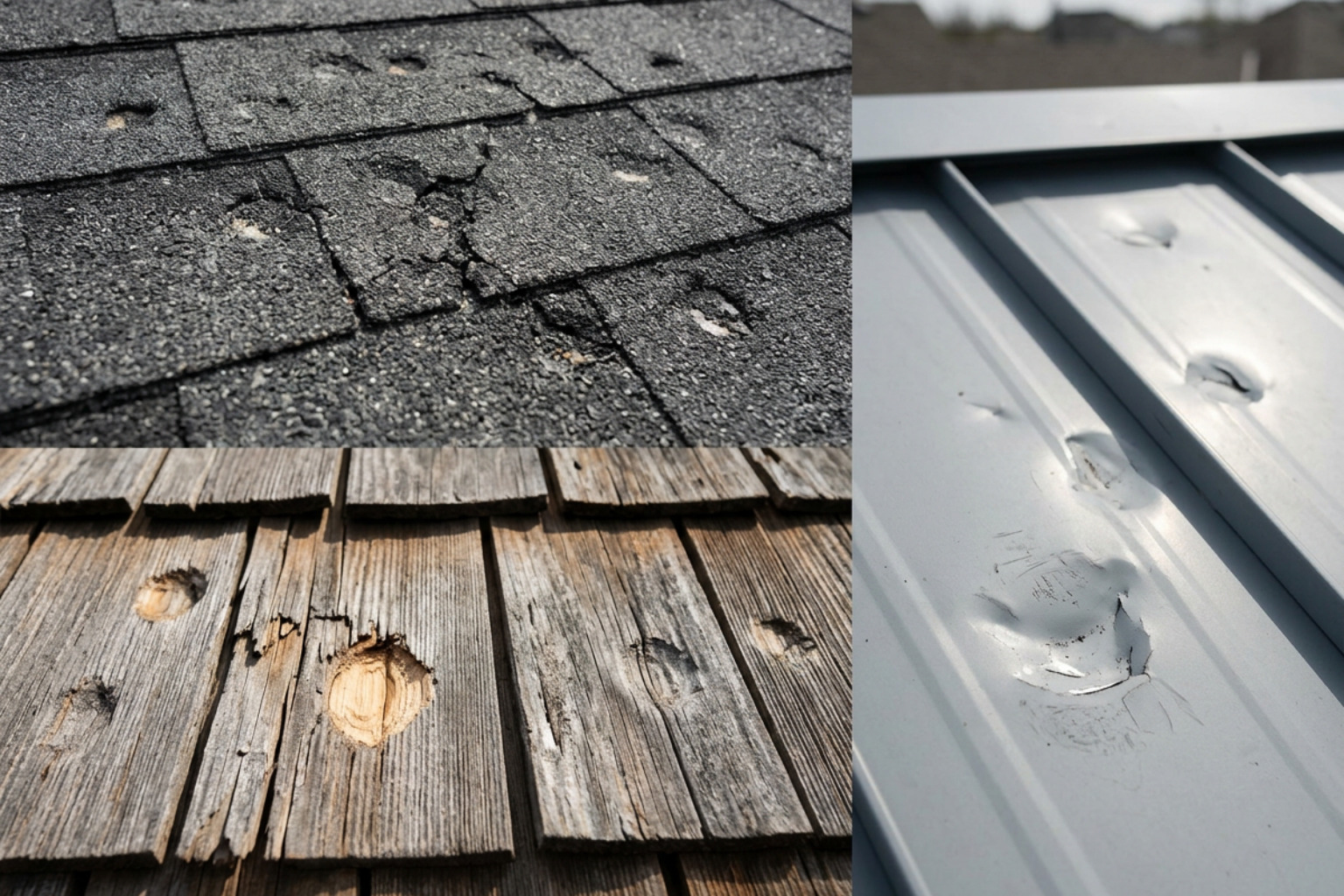
Engaging a professional who understands the nuanced property damage adjuster role ensures your property is measured accurately, all hidden damage is scoped, and your settlement matches genuine local construction costs. From plumbing disasters to specialized public adjusters for roof leaks, independent representation levels the playing field against low opening offers.
Frequently Asked Questions About Property Loss Scopes
How long does an insurer have to provide an estimate after an inspection?
Carrier deadlines vary by state law and policy provisions. In Florida, for example, state statute mandates that once an insurer’s adjuster generates a detailed estimate of the loss, the carrier must provide a copy to the policyholder within seven days. In other jurisdictions, insurers are typically subject to standard prompt-payment statutes requiring a coverage decision or written estimate within 15 to 30 days of completing their field investigation.
Can I cash the initial check if my contractor’s estimate is higher?
Yes, in most situations. Initial claim checks are generally considered undisputed payments toward the actual cash value of your loss. Cashing this initial draft provides the immediate capital needed to secure the property and begin teardown. However, never sign a document marked “Final Settlement,” “Full Release,” or “Satisfaction of Claim” without ensuring the file remains open for future supplements.
Do I have to complete all repairs listed on my property estimate?
If you own the property outright, you have broad discretion over how to apply your claim proceeds, provided you mitigate ongoing damage. However, if you have a mortgage, your lender is listed as a co-payee on settlement checks and will hold the funds in escrow, releasing draws only as licensed contractors complete repairs according to the approved scope. Furthermore, to collect withheld recoverable depreciation, you must submit proof that the repairs were completed at or above the estimated replacement cost.
Conclusion
A property damage estimate is not a take-it-or-leave-it mandate—it is an opening assessment that requires careful line-by-line review. By verifying room dimensions, tracking missing line items, and utilizing the supplement or appraisal process, you can ensure your final settlement covers the true cost of rebuilding.
Hudson Douglas Public Adjusters is a family-owned and operated, locally based Arizona business serving Arizona homeowners and commercial property owners. We represent policyholders only in residential and commercial property insurance claims—never the insurance carriers. With over 40 years of combined property expertise, our team operates with zero upfront fees, receiving a standard 12% fee only when a settlement is successfully recovered.
If you are facing a complex property loss, low estimate, or delayed claim in Paradise Valley, Queen Creek, Gilbert, Scottsdale, Chandler, Goodyear, Mesa, or anywhere across the state, we provide 24/7 bilingual (English/Spanish) advocacy to protect your investment.
Visit Hudson Douglas Public Adjusters today for a complimentary, no-obligation review of your property damage estimate.