When Property Damage Extends Beyond Repair Costs
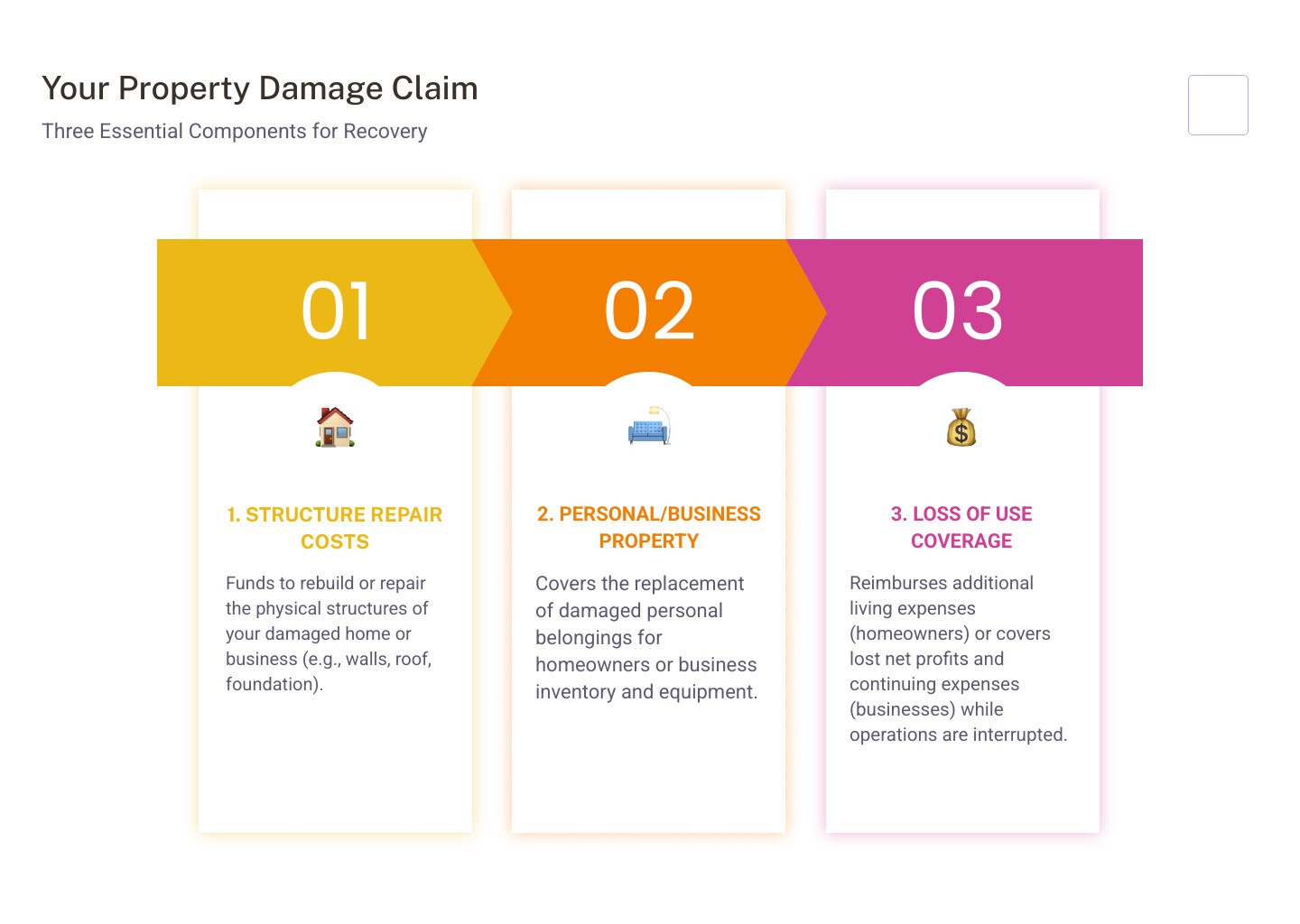
Loss of use property damage refers to the additional costs and lost income you incur when your property is uninhabitable or your business cannot operate due to covered damage. This is separate from the cost to repair or rebuild your property itself.
Quick Answer: What You Need to Know
- For Homeowners: Loss of use (called Additional Living Expenses or ALE) covers temporary housing, increased food costs, storage, pet boarding, and other expenses while your home is being repaired.
- For Business Owners: Loss of use includes Business Interruption coverage (lost profits and continuing expenses like payroll) and Extra Expense coverage (costs to keep operating or minimize closure).
- Coverage Limits: Your policy typically caps loss of use at a percentage of your dwelling coverage (often 20-30%) or a specific time period (commonly 12-24 months).
- Documentation is Critical: You must prove every expense with receipts, invoices, financial records, and a clear timeline.
- The “Period of Restoration” Matters: Coverage begins when the damage occurs and ends when repairs are reasonably complete or you reach your policy limits.
The stress of a fire, flood, or major storm hitting your Arizona home or business is overwhelming enough. But the path to recovery extends far beyond just the cost of repairs.
When your property is uninhabitable or your business is forced to close its doors, you face a second financial blow that many property owners don’t anticipate. You’re suddenly paying for a hotel. Your family is eating restaurant meals instead of cooking at home. Your business is still paying employees and rent, but no customers are walking through the door.
This is loss of use property damage, and it’s a critical part of your insurance claim that often goes undervalued or overlooked entirely.
For Arizona property owners, understanding how to document and claim these damages can mean the difference between a recovery that drains your savings and one that makes you whole. Most insurance companies won’t volunteer this information, and their adjusters are not working to maximize your payout.
This guide will walk you through exactly what loss of use is, how your policy covers it, what documentation you need, and how to avoid the common pitfalls that leave policyholders with far less than they deserve. Whether you’re a homeowner displaced by fire damage or a business owner navigating a shutdown after storm damage, you’ll learn how to protect your rights and secure the full compensation you’re entitled to.
What is ‘Loss of Use’ in a Property Damage Claim?
At its core, loss of use property damage describes the financial impact when your property becomes temporarily unavailable for its normal function due to covered damage. It’s not about the physical damage itself, but the consequences of that damage – the interruption to your daily life or business operations. This interruption is what we refer to as “consequential damages.”
Think of it this way: property ownership isn’t just about having a building; it’s about the right to use that building. When that right is taken away through no fault of your own, you deserve compensation. This concept applies whether you own a residential home in Paradise Valley or a commercial facility in Las Vegas.
For example, if a fire makes your home unlivable, you’ve lost the use of your residence. If a storm damages your storefront, you’ve lost the use of your business premises. In both cases, the inability to use your property as intended incurs additional costs or lost income. Generally, these damages are measured by the rental value of a substitute property or by the financial impact on your operations during the period you’re deprived of its use.

Understanding Additional Living Expenses (ALE) for Homeowners
For homeowners, loss of use typically falls under what’s known as Additional Living Expenses, or ALE. When your home in Gilbert or Henderson becomes unsafe or uninhabitable due to a covered loss, ALE coverage helps you maintain your normal standard of living elsewhere.
This isn’t about replacing your lost property; it’s about covering the extra costs incurred because you can’t live in your home. These can include:
- Temporary housing: The cost of a hotel, rental home, or apartment.
- Increased food costs: If you can’t cook at home, the difference in cost for restaurant meals or takeout.
- Furniture rental: If your temporary housing isn’t furnished.
- Storage fees: For your belongings that need to be moved out of your damaged home.
- Pet boarding: If your pets can’t stay with you in temporary accommodations.
- Extra transportation: For longer commutes or different school routes from your temporary residence.
The key here is “necessary” increases and maintaining a “normal” standard of living. What’s considered “normal” can be subjective, but we believe it should be viewed from your perspective as the insured. If a gym membership was part of your normal routine, for instance, we’d argue for its inclusion if you’re displaced. We work diligently to ensure your ALE claim reflects your actual needs and lifestyle. To learn more about maximizing your residential claim, visit our guide on Maximize Your Residential Property Insurance Claim.
Loss of Use for Commercial Properties: Beyond the Physical Damage
For business owners in Arizona, Nevada, or Utah, loss of use is a crucial component of recovery after property damage. It goes beyond the cost of repairing your building and covers the financial impact on your operations. This typically involves two main coverages: Business Interruption and Extra Expense.
Business Interruption coverage is designed to replace the ordinary income you lose during the period your business is suspended or significantly impacted. This includes:
- Lost net profits: The income your business would have earned if the damage hadn’t occurred.
- Continuing operating expenses: Essential expenses you still have to pay, even if your business isn’t generating revenue, such as payroll, rent or mortgage payments, and utilities.
Without these funds, businesses often struggle to recover. In fact, a significant percentage of businesses never reopen after a major catastrophe because they lack the funds to bridge the gap. Business interruption coverage is a vital tool to prevent business failure.
Extra Expense coverage, on the other hand, helps you keep your business running, or at least minimize the period of closure, by covering necessary additional costs. These are expenses you wouldn’t have incurred otherwise but are essential to continue operations or reduce the impact of the shutdown. Examples include:
- Temporary relocation costs: Renting a temporary office or storefront.
- Equipping a temporary location: Setting up utilities, internet, or necessary equipment.
- Overtime pay: To expedite cleanup or repairs, minimizing downtime.
- Increased shipping costs: To get materials faster.
- Outsourcing: Paying another company to handle some of your operations.
While Business Interruption focuses on replacing lost income, Extra Expense aims to reduce that loss by enabling you to continue working. These two coverages work hand-in-hand to ensure your business can weather the storm. For a comprehensive look at maximizing your commercial claim, consult our guide on Maximize Your Commercial Property Damage Insurance Claim.
How Insurance Policies Cover Loss of Use Property Damage
Understanding how your insurance policy defines and covers loss of use property damage is paramount. Standard property insurance policies define “property damage” in two ways: physical injury to tangible property, or the loss of use of tangible property. Crucially, this means that loss of use can be covered even if your property hasn’t suffered direct physical damage.
The intent behind these definitions, especially in Commercial General Liability (CGL) policies, has historically been to include loss of use even without explicit physical injury. This was clarified years ago to ensure that if, for instance, access to your business is blocked due to damage to a neighboring property, your inability to operate would still be considered a form of property damage.
For insurance purposes, all such loss of use property damage is typically deemed to occur at the time of the “occurrence” that caused the initial damage. This “occurrence” is the trigger for your coverage. However, policies come with specific limits and conditions, including a defined “period of restoration” and various exclusions. It’s important to differentiate between physical damage, loss of use, diminished value, and preventative costs, as insurers often treat them differently. For instance, preventative costs, while potentially reducing future loss of use, are generally not covered unless actual physical injury to tangible property has already occurred.
Decoding Your Policy: Key Terms and Conditions for Loss of Use
Insurance policies are complex documents, often filled with technical language and terms that can be easily misinterpreted. When it comes to loss of use property damage, understanding a few key terms is vital:
- “Period of Restoration”: This defines the timeframe for which your loss of use coverage applies. For business income, it typically begins 72 hours after the damage and ends when your property is repaired or rebuilt with “reasonable speed” and “similar quality.” For extra expense, it usually begins immediately. However, “shortest time required” for repairs should encompass not just physical reconstruction, but also time for permitting, material lead times, and the claim adjustment process itself. This often becomes a point of contention with insurers.
- “Reasonable” and “Necessary” Costs: These subjective terms are often used by insurers to limit payouts. What’s “reasonable” for you to maintain your lifestyle or business operations might be disputed by the insurance company. We advocate that these terms should be interpreted from your perspective, ensuring you’re not unfairly penalized.
- ALE Percentage Limits: For homeowners, your policy usually caps ALE at a percentage of your dwelling coverage (e.g., 20% or 30%) or a specific time limit (e.g., 12 or 24 months). It’s crucial to know these limits upfront.
- Business Interruption Time Limits: Similar to ALE, business interruption coverage often has time limits, typically 12 to 24 months, defining the maximum duration for which you can claim lost income.
- Exclusions for Ordinance or Law: Many policies exclude costs related to bringing your property up to current building codes after damage, often requiring a separate “Ordinance or Law” endorsement. This is critical in areas like Arizona, Nevada, or Utah where building codes can evolve. Without this, you might find yourself paying out of pocket for mandatory upgrades.
These “weasel words” and vague phrases can make navigating your policy a challenge, often leading to disputes. For a deeper dive into common policy challenges, especially concerning water damage, read our article: Why Covered Water Damage Isn’t Always Covered: What Arizona Homeowners Need to Know Before It’s Too Late.
The Critical Difference: The Insurer’s Adjuster vs. Your Public Adjuster
When you file a claim for loss of use property damage, you’ll inevitably interact with an insurance adjuster. It’s vital to understand whose interests they represent. The adjuster assigned by your insurance company works for the insurance company. Their primary goal is to assess the damage and costs from their employer’s perspective, aiming to settle the claim for the lowest amount possible. The burden of proving every aspect of your loss, including loss of use, falls squarely on you, the policyholder.
This is where a public adjuster like us comes in. We work exclusively for you, the policyholder. We are your advocate, leveling the playing field against large insurance companies. As a local, family-owned Arizona business, we understand the specific challenges property owners face in our region. We bring over 50 years of combined expertise to accurately document, estimate, and negotiate your claim, including all aspects of your loss of use.
Our role is to carefully review your policy, identify all applicable coverages, quantify your damages, and present a comprehensive claim to your insurer. We handle the inspections, paperwork, and negotiations, allowing you to focus on rebuilding your life or business. We know that an adjuster cannot ethically work for both you and the insurance company due to the inherent conflict of interest. Our transparent fee structure means we receive 12% of the payout, and you never pay out of pocket. We only get paid when you do. To understand more about our role, visit Public Adjuster vs. Insurance Adjuster.
Calculating and Proving Your Loss of Use Claim
Successfully claiming loss of use property damage hinges on two things: meticulous documentation and proving the “reasonableness” of your expenses or lost income. Insurance companies won’t just take your word for it; you need concrete evidence to back up every dollar.
For homeowners, this means proving that your additional living expenses were both necessary and reasonable to maintain your normal standard of living. For businesses, it involves demonstrating lost profits with “reasonable certainty” and showing that extra expenses were incurred to mitigate further losses or continue operations. The “reasonableness” of the time period for repairs or replacement is also a common point of discussion, and account for all delays, including permitting, material lead times, and the claims process itself.
You have a duty to mitigate damages, meaning you should take reasonable steps to minimize the total loss. This could involve finding a moderately priced rental home instead of the most expensive hotel suite, or implementing cost-effective strategies to keep your business partially operational. We guide our clients through these considerations to build a strong, defensible claim.
A Practical Checklist for Documenting Your Loss of Use Property Damage
To maximize your loss of use property damage claim, thorough documentation is non-negotiable. Here’s a practical checklist of essential documents and actions:
- All receipts for temporary housing, food, and other extra costs: Keep every single receipt, no matter how small. Organize them by category and date.
- Before-and-after photos of the property: Visual evidence of the damage helps establish the necessity of your displacement or business interruption.
- Business financial records: For commercial claims, gather profit and loss statements, tax returns, payroll records, and sales reports from before and after the incident. This helps prove lost profits and continuing expenses.
- Lease agreements for temporary locations: If you’ve rented a temporary home or business space, keep copies of all agreements and payment records.
- A detailed log of all communications with the insurance company: Note dates, times, names of individuals you spoke with, and a summary of the conversation. This includes emails, phone calls, and in-person meetings.
- Proof of payment for utilities at your damaged property: Even if you’re not there, you might still be paying utilities, which are part of your continuing expenses.
- Any contracts or invoices for mitigation efforts: If you paid for temporary repairs to prevent further damage, document those costs.
Common Pitfalls When Filing a Loss of Use Property Damage Claim
Navigating a loss of use property damage claim can be tricky, and many policyholders inadvertently undermine their own claims. Here are some common pitfalls we help our clients avoid:
- Inadequate documentation: This is the most frequent mistake. Without detailed receipts, logs, and financial records, your insurer can easily dispute your claimed expenses.
- Settling too early: Accepting an initial settlement offer without fully understanding the long-term impact of your loss or waiting for all damages to manifest can leave you significantly underpaid. Be wary of offers that require you to release further liability.
- Not understanding your policy limits: Many policyholders aren’t aware of their ALE percentage caps or business interruption time limits, leading to unrealistic expectations or missed opportunities.
- Failing to mitigate the loss: Insurance policies require you to take reasonable steps to prevent further damage or minimize your losses. If you don’t, the insurer might reduce your payout.
- Disagreements over the repair timeline: Insurers may try to argue for a shorter “period of restoration” than is realistic, failing to account for permitting, material delays, or contractor availability. This is a common area where the subjective nature of policy language, often referred to as “weasel words,” can be used against you.
If you’re struggling with a denied claim or suspect your insurer is not treating you fairly, our expertise can make all the difference. Learn more about navigating such situations with our article on Denied Water Damage Claim.
Frequently Asked Questions about Loss of Use
How long can I claim Additional Living Expenses (ALE)?
The duration for which you can claim Additional Living Expenses (ALE) for loss of use property damage is typically outlined in your insurance policy. Most policies will specify either a time limit (commonly 12 or 24 months) or a percentage of your dwelling coverage (often 20% or 30%), whichever comes first.
The coverage usually applies for the “reasonable time required” to repair or replace your damaged home and for your family to return to their normal life. This “reasonable time” should include all practical delays, such as obtaining building permits, waiting for materials, and the actual construction period. It’s crucial to document any delays in the repair process, as this can extend your eligible ALE period. If your home in Queen Creek takes longer than expected to rebuild, we’ll work to ensure your ALE claim reflects that reality, up to your policy limits.
What if my business didn’t lose profits but had to spend more to stay open?
This is precisely what Extra Expense coverage is for under your loss of use property damage claim. Many businesses, especially those providing essential services, cannot afford to shut down completely. Instead, they incur significant additional costs to continue operating.
Extra Expense coverage pays for those “necessary” expenses you wouldn’t have incurred otherwise but were vital to minimize the suspension of operations or keep the business running. This could include:
- Overtime pay for employees working to clean up or set up a temporary location.
- Renting temporary equipment or facilities.
- Expedited shipping costs for crucial supplies or machinery.
- Outsourcing services that you would normally handle in-house.
For example, after a severe Wind & Tornado Damage event in Flagstaff, a local hardware store might rent a temporary tent or portable building to continue selling essential supplies, incurring extra costs for setup, utilities, and perhaps even security. These expenses, intended to keep the business afloat and reduce potential lost profits, would fall under Extra Expense coverage.
Can I claim loss of use if my property wasn’t damaged, but I couldn’t access it?
Yes, in many cases, you can claim loss of use property damage even if your property itself sustained no physical damage. This scenario typically arises when your property becomes inaccessible due to damage to a neighboring property or a civil authority order.
Imagine a large commercial fire at a neighboring business in Scottsdale that leads authorities to cordon off the entire block for safety. Your restaurant, perfectly intact, might be inaccessible to customers for days or weeks. In this situation, you’ve lost the use of your business premises, even though your property wasn’t physically harmed. This is a valid form of loss of use.
Legal precedent supports the idea that loss of use occurs whenever there’s an interruption to the normal use of property, regardless of physical damage. This can be due to physical blockage, a ruptured public utility line, or other events preventing access or normal operation. For further legal context, you can refer to cases like FIE, LLC v. New Jax Condo Association, Inc.. We often see this in Arizona, Nevada, and Utah when natural disasters or accidents affect entire neighborhoods.
Your Advocate in Navigating Complex Claims
Recovering from property damage is a journey, and understanding and claiming loss of use property damage is a vital part of making your family or business whole again. It requires meticulous documentation, a clear understanding of your insurance policy, and persistent negotiation. After a devastating event like a Fire & Smoke Damage or major Water Damage, managing this process alone can feel impossible.
As a local, family-owned Arizona firm, Hudson Douglas Public Adjusters works only for you, the policyholder. We handle the complexities of your claim, ensuring every detail of your loss of use is accurately documented and fairly paid. Our 50+ years of expertise across Arizona, Nevada, and Utah mean we understand the regional nuances of property damage and insurance claims. We are committed to providing calm, steady, and knowledgeable guidance when you need it most. We don’t charge upfront fees; we receive 12% of the payout, so you never pay out of pocket. Hablamos español y estamos aquí para servir a toda nuestra comunidad. If you’re facing a property loss, let our family help yours. Contact us for a complimentary review of your claim.